July 2, 2021 outreach

Observation of gravitational waves from two neutron star-black hole mergers
Observation of gravitational waves from two neutron star-black hole mergers

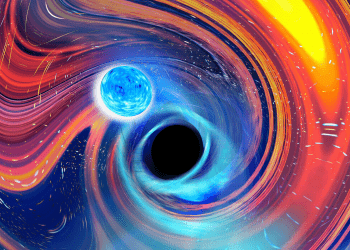
The LIGO-Virgo-KAGRA Scientific Collaboration, has announced the discovery of two neutron star-black hole mergers in the data from the third observing run, separated by 10 days on 5 and 15 January 2021. The IGC LIGO group played a crucial role in this new discovery: Both of these mergers were detected as part of real-time gravitational wave processing conducted by members of the IGC LIGO group. LIGO and Virgo detectors have previously observed the merger of dozens of binary black holes and two binary neutron stars. Neutron star-black hole binaries were believed to exist but this is the first time ever astronomers have witnessed such a phenomena. In each case, the neutron star was likely swallowed whole by its black-hole partner without emitting any electromagnetic radiation. The system observed on January 5 had companion masses of 1.5 solar mass for the neutron star and 5.6 solar mass for the black hole, while the one observed on January 15 had masses 1.9 solar mass for the neutron star and 8.7 solar mass for the black hole. Both the systems came from roughly a distance of 300 Mpc. The details of the announcement can be found in the Penn State News Article.

Full article

About our wordmark
Monica Rincon Ramirez

The IGC wordmark was created by Monica Rincon Ramirez while she was a graduate student at the Institute. Monica enjoys drawing new connections between fundamental theory and observations. Her graduate work included general relativity, loop quantum gravity, and quantum fields in cosmological backgrounds; her thesis focused on effective quantum corrections to gravitational phenomena from spinfoams and applications to cosmology. She received her PhD in 2024.

The wordmark symbolizes the scope of research at the IGC. The base represents quantum gravity, evoking the quantum geometrical picture from spinfoams and loop quantum gravity — approaches studied at the Center for Fundamental Theory. The middle shows galaxies embedded in a smooth surface characteristic of spacetime in general relativity and the larger physical scales studied at the Center for Theoretical and Observational Cosmology. The top curves to an extreme representing a supermassive black hole accompanied by an energetic jet, with a binary black hole pair nearby — the high-energy phenomena studied at the Center for Multimessenger Astrophysics.