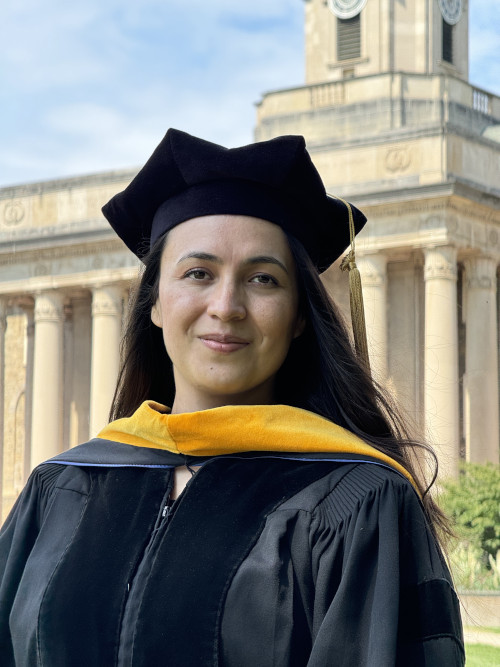
Bojun Zhang

Bojun Zhang — Graduate Student — Graduate Student
Office: 535A Davey Laboratory
Address: 535A Davey Lab, Pennsylvania State University, State College, PA
8142803409
Bojun Zhang

I am a first year graduate student in Astronomy. My research focuses on supermassive black holes and their co-evolution with the host galaxy.

Visit my website

ORCID: 0009-0009-8209-4613

Publications
  1. Bojun Zhang, Fan Zou, W. Brandt, Shifu Zhu, Nathan Cristello, Qingling Ni, Yongquan Xue, Zhibo Yu “Investigating the Star-Formation Characteristics of Radio Active Galactic Nuclei.” arXiv e-prints (2024) doi:10.48550/arXiv.2411.15314

Bojun Zhang's research group


IGC members directory
Photo Name Role Affiliations Email Phone Office Centers Research topics
Bojun Zhang Bojun Zhang Graduate Student Astronomy bjz5234@psu.edu 8142803409 535A Davey Laboratory IGC Astrostatistics, Black Holes, Quasars
About our wordmark
Monica Rincon Ramirez

The IGC wordmark was created by Monica Rincon Ramirez while she was a graduate student at the Institute. Monica enjoys drawing new connections between fundamental theory and observations. Her graduate work included general relativity, loop quantum gravity, and quantum fields in cosmological backgrounds; her thesis focused on effective quantum corrections to gravitational phenomena from spinfoams and applications to cosmology. She received her PhD in 2024.

The wordmark symbolizes the scope of research at the IGC. The base represents quantum gravity, evoking the quantum geometrical picture from spinfoams and loop quantum gravity — approaches studied at the Center for Fundamental Theory. The middle shows galaxies embedded in a smooth surface characteristic of spacetime in general relativity and the larger physical scales studied at the Center for Theoretical and Observational Cosmology. The top curves to an extreme representing a supermassive black hole accompanied by an energetic jet, with a binary black hole pair nearby — the high-energy phenomena studied at the Center for Multimessenger Astrophysics.