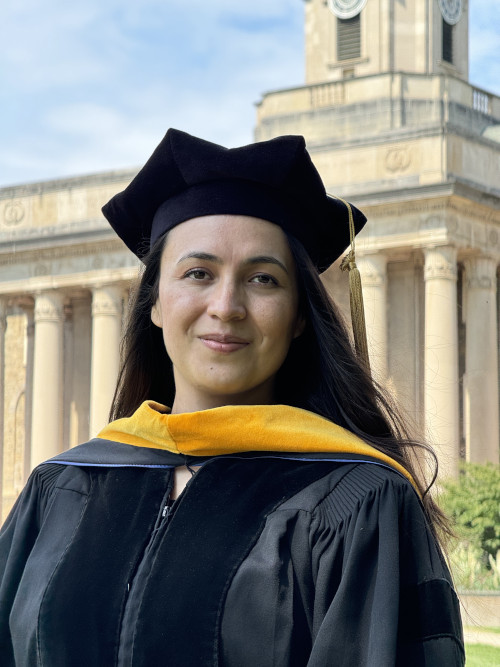
Chad Hanna named Distinguished Professor

Chad Hanna, professor of physics and of astronomy and astrophysics and co-hire of the Institute for Computational and Data Sciences, has been selected to receive the title of distinguished professor in recognition of his exceptional record of teaching, research, and service to the University community. The honor is designated by the Office of the President of Penn State based on the recommendations of colleagues and the dean of the Eberly College of Science.
Hanna is an astrophysicst who focuses on gravitational waves, “ripples" in spacetime predicted by Einstein's theory of general relativity. His research with the Laser Interferometric Gravitational-wave Observatory (LIGO) focuses on detecting gravitational waves emitted just prior to the merging of two neutron stars or black holes. Because these mergers may also result in other electromagnetic or astroparticle emissions, Hanna and the LIGO team conduct real-time, gravitational-wave searches, which enable observations of multiple cosmic “messengers” in order to learn more about these extraordinarily powerful events.
“Chad’s research group has been at the forefront of gravitational-wave astronomy since its inception, and his research and leadership have shaped the field and established Penn State as a leader in multimessenger astrophysics,” said Mauricio Terrones, George A. and Margaret M. Downsbrough Head of the Department of Physics at Penn State. “In addition to his considerable research accomplishments, Chad is a conscientious instructor, an excellent mentor, and a dedicated member of our department and University.”
At LIGO, Hanna developed data analysis pipelines responsible for crucial discoveries such as the gravitational waves generated by the merger of binary black holes and binary neutron stars. The team responsible for this discovery, observed in 2015 and announced by LIGO in 2016, was awarded the 2017 Nobel Prize in physics. Hanna has served as co-chair of the LIGO Computing and Software working group since 2023 and previously served as co-chair of the Compact Binary Coalescence group from 2013 to 2017 and from 2020 to 2022. Alongside the LIGO team, Hanna shared the Special Breakthrough Prize in Physics in 2016, the Gruber Prize in Cosmology in 2016, and the Bruno Rossi Prize in 2017, all from the American Astronomical Society, and the Group Achievement Award from the Royal Astronomical Society in year.
Hanna is also a member of the Penn State Institute for Gravitation and the Cosmos. He received the Faculty Scholar Medal for Outstanding Achievement in from Penn State in 2021, a Faculty Early Career Development (CAREER) award from the U.S. National Science Foundation in 2015, and held the Freed Early Career Professorship in the Penn State Eberly College of Science from 2016 to 2022.
Prior to joining the Penn State faculty in 2014, Hanna was a postdoctoral fellow at the Perimeter Institute for Theoretical Physics in Waterloo, Ontario, Canada from 2010 to 2013 and a postdoctoral scholar in the LIGO Laboratory at the California Institute of Technology. He earned a bachelor's degree in physics at Penn State in 2004, and master's and doctoral degrees in physics at the Louisiana State University in 2006 and 2008, respectively.