News

Two IGC Members recieve Awards from the Fox Graduate School
2026-04-14
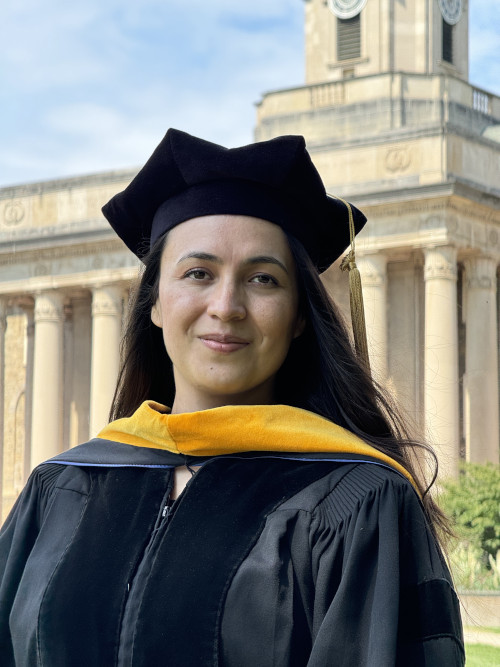
Graduate Student International Research Award Sanika Khadkikar Sanika Khadkikar, a doctoral candidate in physics, is being recognized for her internationally collaborative research on some of the universe’s most extreme objects: neutron stars. These stars, so dense that a teaspoon of their matter would weigh more than a mountain, produce ripples in space‑time when they collide, known as gravitational waves. Sanika’s research focuses on developing new ways to decode these signals to better understand the fundamental physics at play inside neutron stars, including how the universe forges heavy elements such as gold and platinum.
Because gravitational wave science is inherently global, Sanika’s research spans multiple countries and scientific communities. She collaborates with teams at major research centers across Europe, including the University of Southampton in England; the National Centre for Scientific Research in France; the Gran Sasso Science Institute in Italy; the Max Planck Institute in Germany; and Utrecht University in the Netherlands. These groups are instrumental in planning and designing the next generation of gravitational wave observatories: vast, high‑precision instruments that will allow scientists to detect hundreds of thousands of cosmic events each year.
By working directly with international experts who are shaping these future observatories, Sanika is supporting researchers worldwide to accurately interpret the wealth of data these instruments will collect.
Shio Sakon Shio Sakon, a doctoral candidate in physics, is being recognized for transformative contributions that enhance how scientists detect and interpret ripples in spacetime. Working within a gravitational-wave search pipeline known as GstLAL, Sakon contributed to the development of a new method for generating template banks, which are simulated waveforms used to identify real gravitational‑wave signals. This reduced computational time from weeks to hours while maintaining state‑of‑the‑art performance. This innovation enabled faster tuning and the discovery of more than 250 significant events in the most recent LIGO–Virgo–KAGRA Collaboration’s observing run.
Her analyses helped explain several extraordinary detections, including record‑mass black‑hole mergers, and clarified why certain signals stand out in specialized searches. Sakon also leads work on sub‑solar‑mass systems, probing exotic compact‑object scenarios connected to dark‑matter theories, and contributed to population‑inference studies that revealed structures in the black‑hole mass spectrum.
Through advances spanning low‑latency detection, algorithm design and astrophysical interpretation, Sakon’s research ensures that gravitational‑wave astronomy remains fast, reliable and ready for multi‑messenger discovery in the years ahead.
Additional links:

Chad Hanna named Distinguished Professor
2026-02-20
Chad Hanna, professor of physics and of astronomy and astrophysics and co-hire of the Institute for Computational and Data Sciences, has been selected to receive the title of distinguished professor in recognition of his exceptional record of teaching, research, and service to the University community. The honor is designated by the Office of the President of Penn State based on the recommendations of colleagues and the dean of the Eberly College of Science.
Hanna is an astrophysicst who focuses on gravitational waves, “ripples" in spacetime predicted by Einstein’s theory of general relativity. His research with the Laser Interferometric Gravitational-wave Observatory (LIGO) focuses on detecting gravitational waves emitted just prior to the merging of two neutron stars or black holes. Because these mergers may also result in other electromagnetic or astroparticle emissions, Hanna and the LIGO team conduct real-time, gravitational-wave searches, which enable observations of multiple cosmic “messengers” in order to learn more about these extraordinarily powerful events.
“Chad’s research group has been at the forefront of gravitational-wave astronomy since its inception, and his research and leadership have shaped the field and established Penn State as a leader in multimessenger astrophysics,” said Mauricio Terrones, George A. and Margaret M. Downsbrough Head of the Department of Physics at Penn State. “In addition to his considerable research accomplishments, Chad is a conscientious instructor, an excellent mentor, and a dedicated member of our department and University.”
At LIGO, Hanna developed data analysis pipelines responsible for crucial discoveries such as the gravitational waves generated by the merger of binary black holes and binary neutron stars. The team responsible for this discovery, observed in 2015 and announced by LIGO in 2016, was awarded the 2017 Nobel Prize in physics. Hanna has served as co-chair of the LIGO Computing and Software working group since 2023 and previously served as co-chair of the Compact Binary Coalescence group from 2013 to 2017 and from 2020 to 2022. Alongside the LIGO team, Hanna shared the Special Breakthrough Prize in Physics in 2016, the Gruber Prize in Cosmology in 2016, and the Bruno Rossi Prize in 2017, all from the American Astronomical Society, and the Group Achievement Award from the Royal Astronomical Society in year.
Hanna is also a member of the Penn State Institute for Gravitation and the Cosmos. He received the Faculty Scholar Medal for Outstanding Achievement in from Penn State in 2021, a Faculty Early Career Development (CAREER) award from the U.S. National Science Foundation in 2015, and held the Freed Early Career Professorship in the Penn State Eberly College of Science from 2016 to 2022.
Prior to joining the Penn State faculty in 2014, Hanna was a postdoctoral fellow at the Perimeter Institute for Theoretical Physics in Waterloo, Ontario, Canada from 2010 to 2013 and a postdoctoral scholar in the LIGO Laboratory at the California Institute of Technology. He earned a bachelor’s degree in physics at Penn State in 2004, and master’s and doctoral degrees in physics at the Louisiana State University in 2006 and 2008, respectively.
Additional links:

AI-Generated Materials for Dark Matter Detection
2026-01-26
The universe is a mysterious place, and it’s largely composed of mysterious stuff. All of the stuff we can see—galaxies, stars, planets, trees, people—are made of ordinary matter, but this only accounts for about 5 percent of what’s out there. The rest is some combination of so-called “dark matter” and “dark energy.” Scientists have inferred the existence of these mysterious dark entities based on calculations of their gravitational impact on the parts of the universe we can see but have yet to directly observe them.
Carlos Blanco, assistant professor of physics and a co-hire of the Institute for Computational and Data Sciences at Penn State, is using AI to develop materials with properties that will hopefully increase our ability to detect dark matter.
“Dark matter doesn’t emit, reflect, or absorb light, and the only way that we know it interacts with ordinary matter is through its gravitational impact,” said Blanco. “So, we are trying to develop dark matter detectors that could pick up any faint signals that result from dark matter colliding with an ordinary atom. One way to do this is by identifying materials that might be more likely to produce these signals in ways that we can interpret.”
Current dark matter detectors contain some sort of sensor, usually buried deep underground. If a particle of dark matter collides with an atom in the sensor, it might produce a faint signal in the form of light or an excited electron. These events are rare and the signals weak, so the problem becomes how to distinguish a real signal indicating dark matter interacting with the detector and noise in the system resulting from other types of interactions.
“The next generation of dark matter detectors have to be cleverer about how they distinguish an actual dark matter signal from the massive amount of noise inherent in these searches,” said Blanco. “One way to do this is if we can determine the directionality of the interaction—did the dark matter particle come in from above the detector, from the side? So, the problem becomes one of materials science. Can we identify a material that would give us this information? Current detectors have been built with materials that are basically off-the-shelf parts, we want some that is purpose built.”
To identify these materials, Blanco uses machine learning and generative AI. He is building a model, similar to a large-language model, trained on a large database of small molecules—those with around 30 atoms or less—that have some known properties that indicate how sensitive they may be as detectors. The model “learns” how these properties are related to the structure and composition of the molecules in the training set and can suggest new molecules to try to optimize their ability to detect dark matter. It is analogous to how ChatGPT, for example, is trained on existing text, then can produce original sentences.
“As we try to understand the composition and evolution of the universe, our calculations tell us that we are missing as much as 80 percent of the matter; things like galaxies behave like they are five times more massive than what we can detect,” said Blanco. “One of the central problems in particle physics and cosmology is trying to figure out the nature of these missing ingredients in the universe. I studied chemistry as an undergrad and shifted to physics during grad school, but it turns out that this combination of interests allowed me to carve out a niche in this field. Part of the reason I came to Penn State, is that its strengths in materials science make it a playground for folks like me.”
Editor’s Note: This story is part of a larger feature about artificial intelligence developed for the Winter 2026 issue of the Eberly College of Science Science Journal.
Additional links: