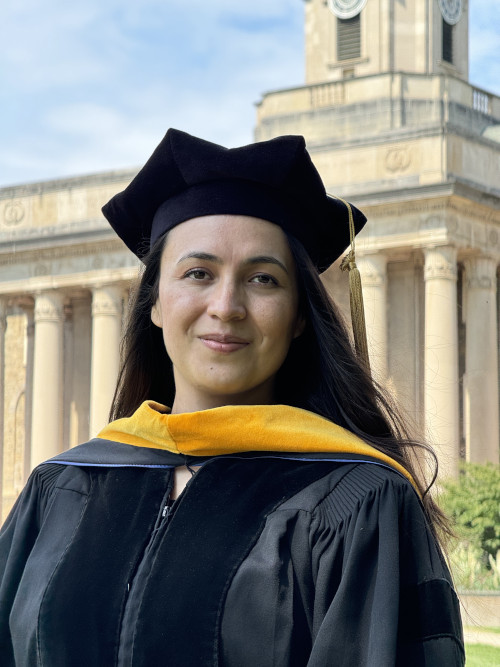
Miguel Mostafa wins 2023 Faculty Scholar Medal

Miguel Alejandro Mostafá, professor of physics and of astronomy and astrophysics and associate dean for research and innovation in the Eberly College of Science, is one of five Penn State faculty members to receive a 2023 Faculty Scholar Medal for Outstanding Achievement. Established in 1980, the award recognizes scholarly or creative excellence represented by a single contribution or a series of contributions around a coherent theme. A committee of peers reviews nominations and selects candidates.
Nominators said Mostafá has significantly advanced the frontiers of fundamental knowledge regarding particle physics and astrophysics. That’s opened unprecedented windows into the physics of our universe.
Mostafá is an experimental particle astrophysicist who researches the origins of the most energetic particles in the Universe. Mostafá uses cosmic messengers in the form of ultrahigh energy cosmic and gamma rays to probe the physics behind cosmic accelerators. He earned the Faculty Scholar Medal in Physical Sciences.
Mostafá conducts this work through international collaborations at the High Altitude Water Cerenkov Gamma-Ray Observatory (HAWC) in Mexico and the Pierre Auger Observatory in Argentina.
“Rising to prominence as a scientist in large physics collaborations such as HAWC or Auger is not an easy endeavor,” a nominator said. “It requires both keen scientific talent and managerial acumen for complex project management.”
At HAWC, Mostafá’s team oversaw the construction of important components of the observatory. His team also produced various analytical tools that led to the discovery of new gamma-ray sources and the most powerful accelerators in our galaxy.
At Auger, Mostafá steered the hardware design and construction and also had a hand in software, analysis and interpretation. Nominators said his background in physics and astrophysics meant he could be the bridge to cross historical boundaries between particle physics and high-energy astrophysics.
At Penn State, Mostafá helped create the Astrophysical Multimessenger Observatory Network (AMON) by serving as principal investigator for the first NSF-funded grant — which was subsequently renewed — on multi-messenger astrophysics. Mostafá oversees several areas of AMON, including oversight of technology solutions, organizing workshops and international partnerships.
“AMON placed Penn State on the international map in this field by pioneering searches that combine signals from various cosmic sources,” a nominator said. “In the past few years, AMON has made major discoveries by combining observations from various observatories. That led to the landmark observation of a ‘flaring blazar’ in coincidence with high energy neutrinos. That discovery was a direct result of Mostafá’s leadership.”
Mostafá is now working on the Giant Radio Array for Neutrino Detection, which nominators say will lead to new discoveries related to multi-messenger astrophysics.
“Mostafá has all the characteristics that embody a true ‘faculty scholar,’” a nominator said. “He is a scientific leader, an inspiring teacher and mentor, and a citizen-scientist contributing energetically to the academic enterprise and to the scientific awareness in broader society.”