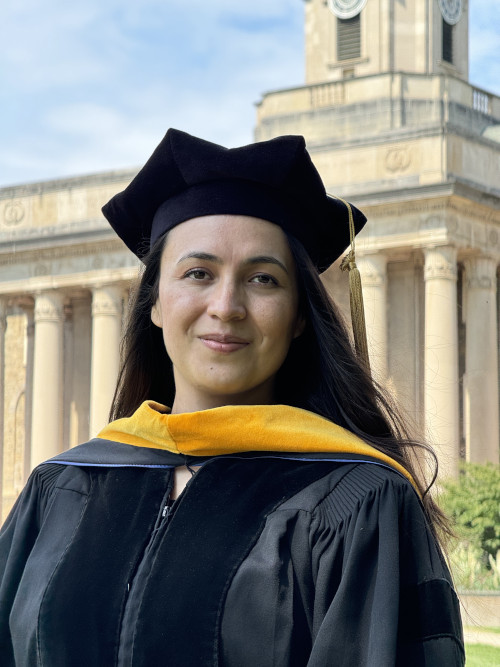
Tristan Weaver
Tristan Weaver
— Graduate Researcher
— Graduate Student
Office: 115 Davey Laboratory
Address: 296 Pollock Rd, State College PA 18602
9494688381

I am a graduate researcher working in the Jeong Cosmology Group and Radice Numerical Relativity Group. My research interests include cosmology, gravity, large scale structure, and the early universe. I develop post-Newtonian models to predict gravitational waveforms in unconventional settings including mass transfer, dark matter, and gravitational wave scattering.
ORCID: 0009-0008-3529-6223
Publications
- Thresa {Kelly}, Connor {Auge}, David {Sanders}, Allison {Kirkpatrick}, Christopher {Carroll}, C. {Urry}, Nico {Cappelluti}, Tonima {Ananna}, Mislav {Balokovi{\'c}}, M{\'e}d{\'e}ric {Boquien}, Brandon {Coleman}, Ryan {Hickox}, Jeyhan {Kartaltepe}, Michael {Koss}, Stefano {Marchesi}, Alessandro {Peca}, Meredith {Powell}, Ezequiel {Treister}, Greg {Troiani}, Tracey {Turner}, Tristan {Weaver} “{Accretion History of AGNs: A Multiwavelength Comparison of X-Ray- and Infrared-selected AGNs}.” \apj 997 2 (2026) doi:10.3847/1538-4357/ae2a32
- Tristan {Weaver}, David {Radice}, Donghui {Jeong}, Victor {Liu} “{Gravitational Wave Modeling of White-Dwarf--Compact-Object Binaries and Observational Outlook}.” arXiv e-prints (2026) doi:10.48550/arXiv.2607.24951
- Tristan Weaver, Han Aung, Daniel Cornwell, Daisuke Nagai, Alfonso Aragón-Salamanca “Reconstructing Filaments around Galaxy Clusters from Spectroscopic Surveys using Machine Learning.” Research Notes of the American Astronomical Society 7 12 (2023) doi:10.3847/2515-5172/ad148d