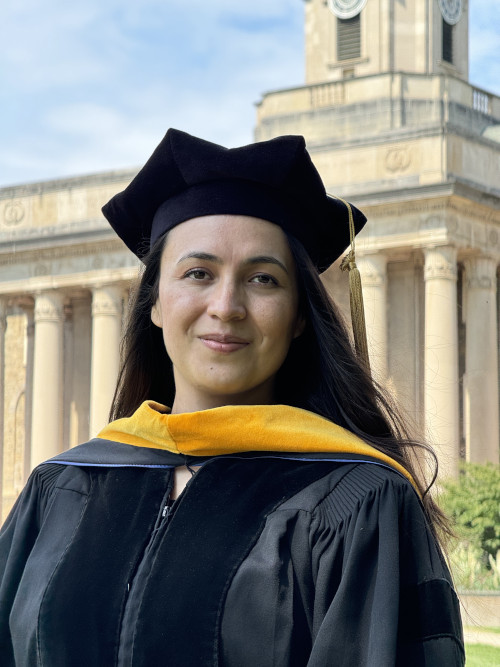
Stephanie Wissel

Stephanie Wissel's work centers on multi-messenger astrophysics, with a particular emphasis on ultra-high energy neutrinos. Neutrinos play a key role in this growing field that combines observations from neutrinos, photons, cosmic rays, and gravitational waves to understand particle accelerators and the extreme physics that drives them. Recognizing that neutrinos interact rarely and the most energetic of them are quite rare, I am involved in several experiments that use efficient radio detection techniques to maximize the chance of a discovery in a new energy regime (>10 PeV). She currently works on ARA, BEACON, PUEO, RNO-G, and IceCube-Gen2. She has been recognized for her work with an NSF CAREER Award as the PI on the BEACON experiment and with a Downsbrough Early Career Development Professorship in Physics
Stephanie started her career at the University of Dallas where she received a B.S. in Physics in 2004. She started studying multi-messenger astrophysics as a graduate student at the University of Chicago working on both the gamma ray and cosmic ray astrophysics with the VERITAS and TrICE experiments, graduating in 2010. She went on to a postdoc at the Princeton Plasma Physics Lab doing work in Science Education and plasma physics. In 2012, she started working on radio detection of neutrinos at UCLA with the ANITA and T-510 experiments. She was a professor at the California Polytechnic State University from 2015 to 2019, expanding her work on radio neutrino experiments to ANITA, ARA, BEACON, RNO-G, and related efforts.
Stephanie likes Scrabble, cooking, photography, traveling and hiking with her family.
Publications
- R. Prechelt, others “Analysis of a tau neutrino origin for the near-horizon air shower events observed by the fourth flight of the Antarctic Impulsive Transient Antenna.” Phys. Rev. D 105 4 (2022) doi:10.1103/PhysRevD.105.042001
- M. Aartsen, others “IceCube-Gen2: the window to the extreme Universe.” J. Phys. G 48 6 (2021) doi:10.1088/1361-6471/abbd48
- Q. Abarr, others “The Payload for Ultrahigh Energy Observations (PUEO): a white paper.” JINST 16 08 (2021) doi:10.1088/1748-0221/16/08/P08035
- J. Aguilar, others “Design and Sensitivity of the Radio Neutrino Observatory in Greenland (RNO-G).” JINST 16 03 (2021) doi:10.1088/1748-0221/16/03/P03025
- Stephanie Wissel, others “Prospects for high-elevation radio detection of 100 PeV tau neutrinos.” JCAP 11 (2020) doi:10.1088/1475-7516/2020/11/065
- P. Allison, others “Design and performance of an interferometric trigger array for radio detection of high-energy neutrinos.” Nucl. Instrum. Meth. A 930 (2019) doi:10.1016/j.nima.2019.01.067
- P. Gorham, others “Constraints on the ultrahigh-energy cosmic neutrino flux from the fourth flight of ANITA.” Phys. Rev. D 99 12 (2019) doi:10.1103/PhysRevD.99.122001
- A. Romero-Wolf, others “Comprehensive analysis of anomalous ANITA events disfavors a diffuse tau-neutrino flux origin.” Phys. Rev. D 99 6 (2019) doi:10.1103/PhysRevD.99.063011
- J. Avva, others “Development Toward a Ground-Based Interferometric Phased Array for Radio Detection of High Energy Neutrinos.” Nucl. Instrum. Meth. A 869 (2017) doi:10.1016/j.nima.2017.07.009
- K. Belov, others “Accelerator measurements of magnetically-induced radio emission from particle cascades with applications to cosmic-ray air showers.” Phys. Rev. Lett. 116 14 (2016) doi:10.1103/PhysRevLett.116.141103
Stephanie Wissel's research group
| Photo | Name | Role | Affiliations | Phone | Office | Centers | Research topics | |
|---|---|---|---|---|---|---|---|---|

|
Julien Alfaro | Graduate Student | Physics | jpa5771@psu.edu | +1 814 865 7533 | 204 Osmond Laboratory | CMA, IGC | Cosmic Rays, Multimessenger Astrophysics, Neutrinos |

|
Bryan Hendricks | Graduate Student | Physics | blh5615@psu.edu | 815-216-0835 | 204 Osmond Laboratory | IGC | Neutrinos |

|
Ryan Krebs | Graduate Student | Physics | rjk5416@psu.edu | (814) 865-7533 | 322 Osmond Laboratory | CMA, IGC | Multimessenger Astrophysics, Neutrinos |

|
Yuchieh Ku | Graduate Student | Physics | yuchieh@psu.edu | 8148628153 | 204 Osmond Laboratory | IGC | Neutrinos |

|
Laurel Oneill | Postdoc | Astronomy | laurel@psu.edu | NA | 428 Davey Laboratory | IGC | Cosmic Rays |

|
Andrew Zeolla | Graduate Student | Physics | avz5228@psu.edu | 7138709006 | 204 Osmond Laboratory | CMA | Cosmic Rays, Multimessenger Astrophysics, Neutrinos |
Stephanie Wissel's former group members
| Photo | Name | Role | Affiliations | Phone | Office | Centers | Research topics | |
|---|---|---|---|---|---|---|---|---|

|
Kaeli Hughes | Postdoc | Astronomy, Physics | kaeli@psu.edu | +1 6142906343 | N/A Davey Laboratory | CMA | Cosmic Rays, Multimessenger Astrophysics, Neutrinos |

|
Marco Muzio | Faculty | Astronomy, Physics | msm6428@psu.edu | – | 322 Whitmore Laboratory | CMA | Cosmic Rays, Multimessenger Astrophysics, Neutrinos |

|
Christoph Welling | Postdoc | Astronomy | cjw7007@psu.edu | – | 206 D Whitmore Laboratory | IGC | Multimessenger Astrophysics |