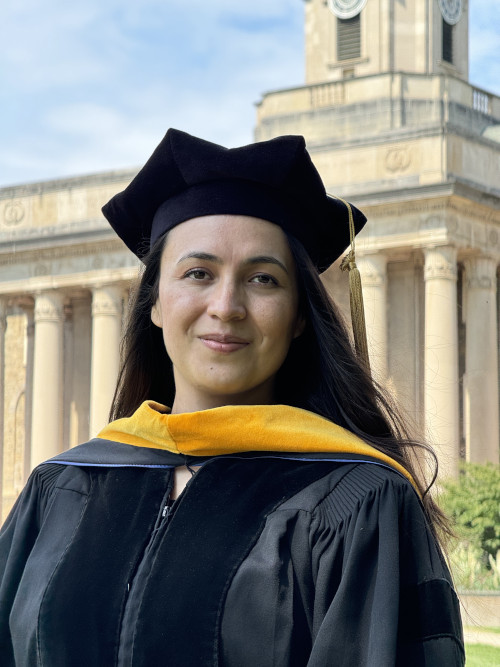
Steinn Sigurdsson

Steinn Sigurdsson is currently a Professor of Astrophysics at the Pennsylvania State University at University Park. He did his doctorate in theoretical physics at the California Institute of Technology in Pasadena, California. He then worked as a researcher at the University of California at Santa Cruz, and the Institute of Astronomy and King’s College at Cambridge University in England. Steinn is a member of the Institute for Gravitation and the Cosmos and the Center for Exoplanets and Habitable Worlds, and the Penn State Astrobiology Research Center. He works on a range of topics in astrophysics and related areas, ranging from cosmology, large scale dynamics and black holes, to formation and evolution of planets, and the prospects for discovering non-terrestrial life. He served as a Trustee of the Aspen Center for Physics and has been a member of the board of the Aspen Center for Physics since 2010.
Publications
- Peter Breiding, Sarah Burke-Spolaor, Michael Eracleous, Tamara Bogdanović, T. Lazio, Jessie Runnoe, Steinn Sigurdsson “The Search for Binary Supermassive Black Holes among Quasars with Offset Broad Lines Using the Very Long Baseline Array.” 914 1 (2021) doi:10.3847/1538-4357/abfa9a
- Khai Nguyen, Tamara Bogdanović, Jessie Runnoe, Stephen Taylor, Alberto Sesana, Michael Eracleous, Steinn Sigurdsson “Pulsar Timing Array Constraints on the Merger Timescale of Subparsec Supermassive Black Hole Binary Candidates.” 900 2 (2020) doi:10.3847/2041-8213/abb2ab
- Jason Wright, Steinn Sigurdsson “Advances in Precise Radial Velocimetry From Cross-Disciplinary Work in Heliophysics, Stellar Astronomy, and Instrumentation.” arXiv e-prints (2019)