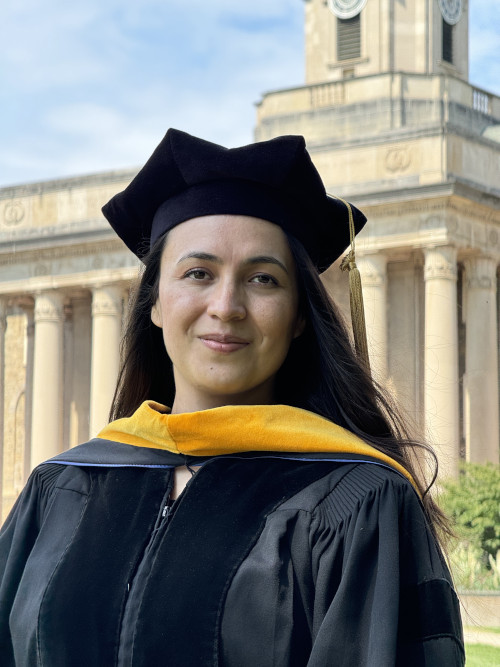
Rahul Kashyap

My name is Rahul Kashyap. I study astrophysical objects using both, computational and analytical methods. I work on hydrodynamical simulations of binary white dwarf (BWD) and binary neutron star (BNS) mergers and transients obtained from them. I am also interested in combining information from gravitational wave data analysis and several physical constraints obtained from them.
Currently, I am a Postdoctoral Scholar, in the Eberly College of Science, Department of Physics, Pennsylvania State University, USA working with David Radice and Bangalore Sathyaprakash. Please visit the group site — Rahul Kashyap – NumRel@PSU to know more about the numerical relativity group at Penn State led by David Radice.
I am a member of LIGO-Virgo collaboration participating in enriching our astrophysical knowledge by performing hydrodynamical simulations as well as gravitational-wave data analysis. More specifically, I am working on hydrodynamical modeling of the kilonova ejecta and astrophysical implications from parametric Bayesian inferences using individual gravitational wave sources.
I have obtained my Ph. D. in Computational Astrophysics from UMASS Dartmouth with Prof. Robert Fisher where I discovered a new possible mechanism for the formation of Type Ia supernovae from binary white dwarf mergers. You can see my Ph.D. thesis here. I am studying the evolution of post-merger binary WD merger evolution and their outcomes such as accretion-induced collapse to form neutron stars. In the past, I was Max Planck postdoctoral fellow at International Centre for Theoretical Sciences, Bengaluru, India.
My CV and publication list are available if you are interested.
I use this site to share my research work and some thoughts on topics of my other interests in the form of short infrequent posts. Send me an email at this address to talk about interesting natural philosophy i.e. modern science. My institute home page is here.
Here is my older personal site – https://rahulkashyap411.github.io/#About
Publications
- Zhenyu Wu, Giacomo Ricigliano, Rahul Kashyap, Albino Perego, David Radice “Radiation hydrodynamics modelling of kilonovae with SNEC.” Mon. Not. R. Astron. Soc. 512 1 (2022) doi:10.1093/mnras/stac399
- Rahul Kashyap, Abhishek Das, David Radice, Surendra Padamata, Aviral Prakash, Domenico Logoteta, Albino Perego, Daniel Godzieba, Sebastiano Bernuzzi, Ignazio Bombaci, Farrukh Fattoyev, Brendan Reed, André Schneider “Numerical relativity simulations of prompt collapse mergers: threshold mass and phenomenological constraints on neutron star properties after GW170817.” (2021)
- A Perego, D Logoteta, D Radice, S Bernuzzi, R Kashyap, A Das, S Padamata, A Prakash “Probing the incompressibility of nuclear matter at ultra-high density through the prompt collapse of asymmetric neutron star binaries.” (2021)
- Nathan Johnson-Mcdaniel, Arunava Mukherjee, Rahul Kashyap, Parameswaran Ajith, Walter Del Pozzo, Salvatore Vitale “Constraining black hole mimickers with gravitational wave observations.” 12 (2020) doi:10.1103/PhysRevD.102.123010
- Rahul Kashyap, Gayathri Raman, Parameswaran Ajith “Can Kilonova Light curves be Standardized?.” Astrophys. J. Lett. 886 1 (2019) doi:10.3847/2041-8213/ab543f
- Rahul Kashyap, Tazkera Haque, Pablo Lorén-Aguilar, Enrique García-Berro, Robert Fisher “Double-degenerate Carbon-Oxygen and Oxygen-Neon White Dwarf Mergers: A New Mechanism for Faint and Rapid Type Ia Supernovae.” Astrophys. J. 869 2 (2018) doi:10.3847/1538-4357/aaedb7
- Pranav Dave, Rahul Kashyap, Robert Fisher, Frank Timmes, Dean Townsley, Chris Byrohl “Constraining The Single-Degenerate Channel of Type Ia Supernovae With Stable Iron-Group Elements in SNR 3C 397.” Astrophys. J. 841 1 (2017) doi:10.3847/1538-4357/aa7134
- Rahul Kashyap, Robert Fisher, Enrique García-Berro, Gabriela Aznar-Siguán, Suoqing Ji, Pablo Lorén-Aguilar “One-Armed Spiral Instability in Double-Degenerate Post-Merger Accretion Disks.” Astrophys. J. 840 1 (2017) doi:10.3847/1538-4357/aa6afb
- Daniel Rossum, Rahul Kashyap, Robert Fisher, Ryan Wollaeger, Enrique Garcia-Berro, Gabriela Aznar-Siguan, Suoqing Ji, Pablo Loren-Aguilar “Light Curves and Spectra from a Thermonuclear Explosion of a White Dwarf Merger.” Astrophys. J. 827 2 (2016) doi:10.3847/0004-637X/827/2/128
- Rahul Kashyap, Robert Fisher, Enrique García-Berro, Gabriela Aznar-Siguán, Suoqing Ji, Pablo Lorén-Aguilar “Spiral instability can drive thermonuclear explosions in binary white dwarf mergers.” Astrophys. J. Lett. 800 1 (2015) doi:10.1088/2041-8205/800/1/l7