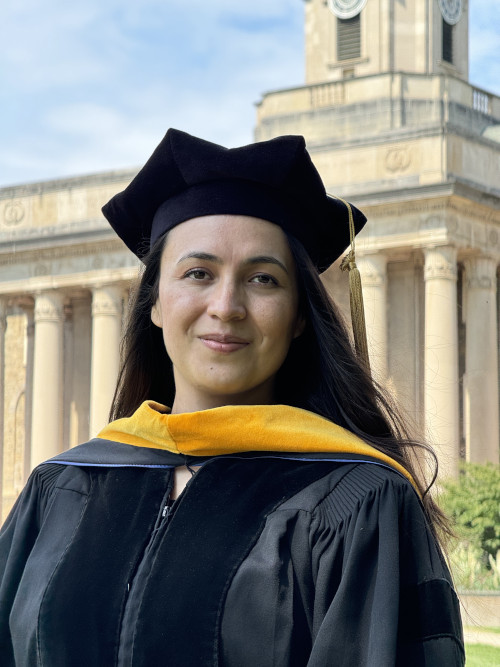
Olivia Curtis

My primary interest is in cosmic voids—the largest, most underdense, and least studied regions of the universe—as laboratories for large-scale clustering and pristine modes of galaxy evolution. Because voids are underdense in baryonic and dark matter, I have used void statistics like the void size and shape functions to constrain the dark energy equation of state, the amplitude of matter density fluctuations, and the matter density parameter. I am also interested in understanding the linear clustering bias within cosmic voids, since, when treated as weak, inverse gravitational lenses, voids also produce negative tangential shears in galaxy projections that can also constrain their mass distributions. Lastly, I am interested in using cosmic voids as tests for astrophysics—measuring how so-called "void galaxies" undergo delayed evolutions due to their location within large, pristine environments, which enables population-level tests of (i) whether burstiness is driven primarily by mergers or by internal processes, (ii) how star-formation efficiency and chemical enrichment depend on local large-scale density, and (iii) how the triggering of the AGN phenomenon varies across the cosmic web.
ORCID: 0000-0002-0212-4563
Publications
- Olivia Curtis, Bryanne McDonough, Tereasa Brainerd “Luminosity Functions and Mass-Size Relations for Void Galaxies in the Complete SDSS DR7.” ApJ (in preparation)
- Olivia Curtis, Bryanne McDonough, Tereasa Brainerd “Void Galaxies and Active Galactic Nucleus Activity in ZOBOV-identified TNG300 Voids from z = 3 to z = 0.” ApJ 998 2 (2026) doi:10.3847/1538-4357/ae2f48
- Olivia Curtis, Bryanne McDonough, Tereasa Brainerd “Density Profiles of TNG 300 Voids across Cosmic Time.” ApJ 985 2 (2025) doi:10.3847/1538-4357/adcebf
- Olivia Curtis, Robin Ciardullo “Void Galaxies in the Spitzer/HETDEX Exploratory Large-Area (SHELA) survey.” 246 (2025)
- Olivia Curtis, Bryanne McDonough, Tereasa Brainerd “Properties of Voids and Void Galaxies in the TNG300 Simulation.” ApJ 962 1 (2024) doi:10.3847/1538-4357/ad18b4
- O. Curtis, T. Brainerd, A. Hernandez “Cosmic voids in GAN-generated maps of large-scale structure.” Astronomy and Computing 38 (2022)