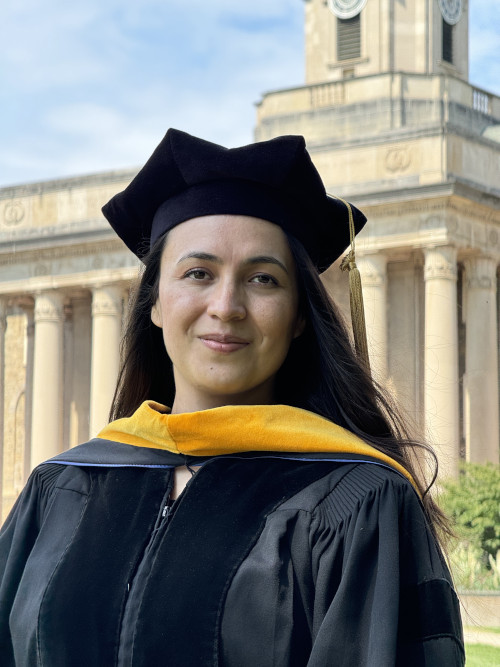
Michael Ryan

Michael is a 5th year graduate student working in the dissipative dark matter group on dark chemistry and dark object formation. Michael is the primary developer of the DarkKROME extension (found at https://www.bitbucket.org/mtryan83/darkkrome) to the KROME software package, which adds atomic dark matter chemistry to KROME. He is also working with David Radice on dark white dwarfs, looking into their properties and running simulations on the mergers to investigate possible GW signals. Michael has a M.S in Applied Physics from Johns Hopkins and a B.S. in Physics, Math, and Computer Science from Dickinson College.
ORCID: 0000-0002-0378-5195
Publications
- James Gurian, Donghui Jeong, Michael Ryan, Sarah Shandera “Molecular Chemistry for Dark Matter. II. Recombination, Molecule Formation, and Halo Mass Function in Atomic Dark Matter.” ApJ 934 2 (2022) doi:10.3847/1538-4357/ac75e4
- Michael Ryan, James Gurian, Sarah Shandera, Donghui Jeong “Molecular Chemistry for Dark Matter.” ApJ 934 2 (2022) doi:10.3847/1538-4357/ac75ef
- Michael Ryan, Sarah Shandera, James Gurian, Donghui Jeong “Molecular Chemistry for Dark Matter. III. DarkKROME.” ApJ 934 2 (2022) doi:10.3847/1538-4357/ac75e5
- Michael Ryan, David Radice “Exotic compact objects: The dark white dwarf.” PhysRevD 105 11 (2022) doi:10.1103/physrevd.105.115034
Michael Ryan's research group
| Photo | Name | Role | Affiliations | Phone | Office | Centers | Research topics | |
|---|---|---|---|---|---|---|---|---|

|
John Blakely | Undergraduate Student | Astronomy, Physics | jpb6799@psu.edu | +1 814 865 0410 | Osmond Laboratory | CTOC, IGC | Black Holes, Dark Matter |