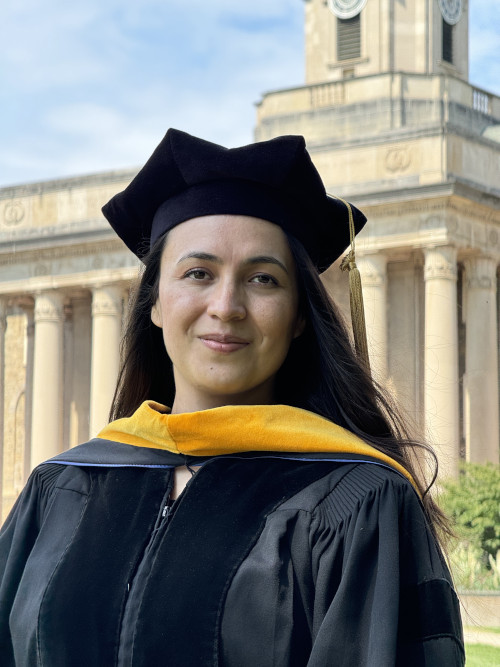
Carmen Carmona Benitez

I am an assistant professor of physics at Penn State University and a member of the Institute for Gravitation and the Cosmos (IGC). I have been a faculty member of Penn State since 2017. I am a particle astrophysicist working on the hunt for dark matter, the “invisible” matter that makes up 85 percent of the matter in the Universe! I was a key member of the Large Underground Xenon (LUX) experiment, the most sensitive dark matter detector until its decommission in 2017. I am now working on the LUX-ZEPLIN (LZ) experiment, the largest dark matter detector ever built, one mile underground in a former gold mine in South Dakota. LZ, an international collaboration of 250 scientists, will be at the forefront of the search for dark matter in the next decade. My group leads efforts in the cryogenics and xenon circulation system, commissioning and operation of the detector, bias mitigation techniques, background simulations and WIMP data analysis.
Publications
- D. Akerib, others “Simulations of Events for the LUX-ZEPLIN (LZ) Dark Matter Experiment.” Astropart. Phys. 125 (2021) doi:10.1016/j.astropartphys.2020.102480
- D. Akerib, others “Projected sensitivity of the LUX-ZEPLIN experiment to the two-neutrino and neutrinoless double β decays of ^134Xe.” Phys. Rev. C 104 6 (2021) doi:10.1103/PhysRevC.104.065501
- D. Akerib, others “Effective field theory analysis of the first LUX dark matter search.” Phys. Rev. D 103 12 (2021) doi:10.1103/PhysRevD.103.122005
- D. Akerib, others “Improving sensitivity to low-mass dark matter in LUX using a novel electrode background mitigation technique.” Phys. Rev. D 104 1 (2021) doi:10.1103/PhysRevD.104.012011
- D. Akerib, others “Constraints on effective field theory couplings using 311.2 days of LUX data.” Phys. Rev. D 104 6 (2021) doi:10.1103/PhysRevD.104.062005
- D. Akerib, others “Projected sensitivities of the LUX-ZEPLIN experiment to new physics via low-energy electron recoils.” Phys. Rev. D 104 9 (2021) doi:10.1103/PhysRevD.104.092009
- D. Akerib, others “Search for two neutrino double electron capture of ^124Xe and ^126Xe in the full exposure of the LUX detector.” J. Phys. G 47 10 (2020) doi:10.1088/1361-6471/ab9c2d
- D. Akerib, others “Projected sensitivity of the LUX-ZEPLIN experiment to the 0νββ decay of ^136Xe.” Phys. Rev. C 102 1 (2020) doi:10.1103/PhysRevC.102.014602
- D. Akerib, others “The LUX-ZEPLIN (LZ) Experiment.” Nucl. Instrum. Meth. A 953 (2020) doi:10.1016/j.nima.2019.163047
- D. Akerib, others “Calibration, event reconstruction, data analysis, and limit calculation for the LUX dark matter experiment.” Phys. Rev. D 97 10 (2018) doi:10.1103/PhysRevD.97.102008
Carmen Carmona Benitez's research group
| Photo | Name | Role | Affiliations | Phone | Office | Centers | Research topics | |
|---|---|---|---|---|---|---|---|---|

|
Yen-Ting Chin | Graduate Student | Physics | ypc5402@psu.edu | 18144248968 | Osmond Laboratory | CMA | Dark Matter |

|
Jack Genovesi | Postdoc | Physics | jgg27@psu.edu | 8455197418 | 320A Osmond Laboratory | IGC | Dark Matter |

|
Katherine Wild | Graduate Student | Physics | kvw5673@psu.edu | (954) 225-1854 | 108 Osmond Laboratory | IGC | Dark Matter |

|
Wei Zha | Graduate Student | Physics | wpz5141@psu.edu | – | 114 Whitmore Laboratory | IGC | Dark Matter |
Carmen Carmona Benitez's former group members
| Photo | Name | Role | Affiliations | Phone | Office | Centers | Research topics | |
|---|---|---|---|---|---|---|---|---|

|
Daniel Kodroff | Graduate Student | Physics | dsk192@psu.edu | 0000000000 | Basement Osmond Laboratory | CMA | Dark Matter, Neutrinos |