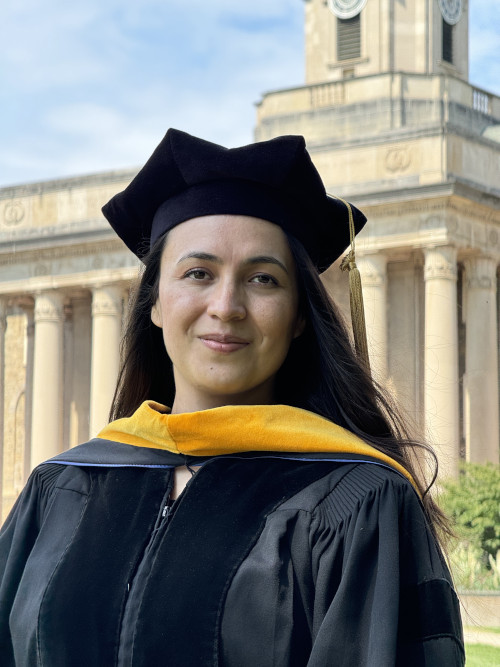
Luiz de Viveiros

My research to tries to answer one of the Big Questions in science: what is the universe made of? My research focuses on neutrinos, the most abundant known massive particle in the universe, and the search for dark matter, the unknown stuff that makes up more than 80% of the matter in the universe!
I have a long history of working on dark matter experiments, having been part of CMDS-II, XENON10, ZEPLIN-III, and the Large Underground Xenon (LUX); and I am currently working on the LUX-ZEPLIN (LZ) experiment, a next-generation dark-matter detector that will be the most sensitive search over the next decade. More recently, I have been working on the Project 8 Neutrino Mass experiment. Although the neutrino was discovered almost 60 years ago, it’s one of nature’s most elusive particles, and we still don’t know one of its most fundamental properties, its mass. The Project 8 experiment seeks to determine the neutrino mass by precisely measuring the energy spectrum of Tritium beta decay, using a technique that allows the measurement of individual electrons in a magnetic trap, called Cyclotron Radiation Emission Spectroscopy (CRES).
I am originally from São Luís in Brasil, but I did both my undergraduate and graduate studies in the US. I have a Bachelors Degree from Clark University in Massachusetts, where I majored in Physics and Philosophy, and worked in the Organic Superconductors Lab. I got my PhD in Physics at Brown University, where I was part of the Particle Astrophysics Group, and my advisor was Prof. Richard Gaitskell. During my graduate studies, I worked on the XENON, LUZ and LZ experiments. XENON10 was located at the Gran Sasso Underground Labs, about 1 hour northeast of Rome, so I got to spend a year living in Italy. I also spent 4 years living in Portugal, where I did a Postdoc at Laboratório de Instrumentação e Física Experimental de Partícula (LIP) in Coimbra; and 3 years in Santa Barbara, California (USA), where I did another postdoc at the University of California, Santa Barbara (undoubtedly the most beautifully located campus ever!).
ORCID: 0000-0002-7038-2361
Publications
- J. Aalbers, others “A Next-Generation Liquid Xenon Observatory for Dark Matter and Neutrino Physics.” (2022)
- D. Akerib, others “Fast and Flexible Analysis of Direct Dark Matter Search Data with Machine Learning.” (2022)
- A. Esfahani, others “The Project 8 Neutrino Mass Experiment.” (2022)
- A. Ashtari Esfahani, others “Bayesian analysis of a future β decay experiment's sensitivity to neutrino mass scale and ordering.” Phys. Rev. C 103 6 (2021) doi:10.1103/PhysRevC.103.065501
- A. Esfahani, others “Viterbi Decoding of CRES Signals in Project 8.” (2021)
- D. Akerib, others “Simulations of Events for the LUX-ZEPLIN (LZ) Dark Matter Experiment.” Astropart. Phys. 125 (2021) doi:10.1016/j.astropartphys.2020.102480
- D. Akerib, others “Constraints on effective field theory couplings using 311.2 days of LUX data.” Phys. Rev. D 104 6 (2021) doi:10.1103/PhysRevD.104.062005
- D. Akerib, others “Projected sensitivities of the LUX-ZEPLIN experiment to new physics via low-energy electron recoils.” Phys. Rev. D 104 9 (2021) doi:10.1103/PhysRevD.104.092009
- D. Akerib, others “Investigation of background electron emission in the LUX detector.” Phys. Rev. D 102 9 (2020) doi:10.1103/PhysRevD.102.092004
- D. Akerib, others “The LUX-ZEPLIN (LZ) radioactivity and cleanliness control programs.” Eur. Phys. J. C 80 11 (2020) doi:10.1140/epjc/s10052-020-8420-x
Luiz de Viveiros's research group
| Photo | Name | Role | Affiliations | Phone | Office | Centers | Research topics | |
|---|---|---|---|---|---|---|---|---|

|
Srinikitha Bhagvati | Graduate Student | Physics | skb6413@psu.edu | – | 108 Osmond Laboratory | CMA | Dark Matter |

|
Yen-Ting Chin | Graduate Student | Physics | ypc5402@psu.edu | 18144248968 | Osmond Laboratory | CMA | Dark Matter |

|
Salvatore Cordova | Staff | Physics | sac6821@psu.edu | 857891241 | NA Osmond Laboratory | IGC | |

|
Reagen Garcia | Graduate Student | Physics | rgarcia@psu.edu | --- | 114 Osmond Laboratory | CMA | Neutrinos |

|
Richard Mueller | Graduate Student | Physics | rjm6826@psu.edu | +1 814 865 7533 | 6E Osmond Laboratory | IGC | Neutrinos |

|
Katherine Wild | Graduate Student | Physics | kvw5673@psu.edu | (954) 225-1854 | 108 Osmond Laboratory | IGC | Dark Matter |

|
Wei Zha | Graduate Student | Physics | wpz5141@psu.edu | – | 114 Whitmore Laboratory | IGC | Dark Matter |

|
Andrew Ziegler | Graduate Student | Physics | ziegler@psu.edu | – | 6E Osmond Laboratory | CMA | Neutrinos |
Luiz de Viveiros's former group members
| Photo | Name | Role | Affiliations | Phone | Office | Centers | Research topics | |
|---|---|---|---|---|---|---|---|---|

|
Daniel Kodroff | Graduate Student | Physics | dsk192@psu.edu | 0000000000 | Basement Osmond Laboratory | CMA | Dark Matter, Neutrinos |