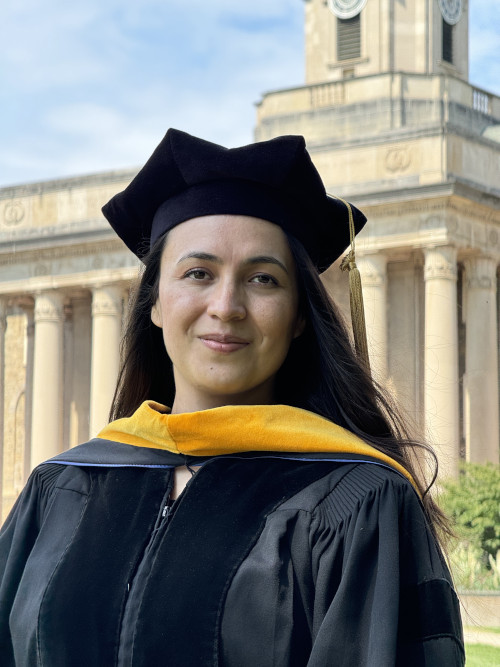
Källan Berglund

I am a PhD Candidate in the Institute for Gravitation and the Cosmos, Center for Fundamental Theory researching quantum gravity, specifically modified black hole spacetimes with quantum corrections. I am interested in the nature of spacetime and enjoy the mathematical challenges of working with complex geometries. I have additional interests in testing quantum gravity, gravitational wave quasinormal modes, analog gravity, evidence-based pedagogy, community building, and equity/diversity/inclusion advocacy.
I graduated with Honors in Astrophysics from Brown with my thesis refuting a black hole firewall model. My early work includes an RI NASA Space Grant researching star formation rates in galaxy clusters, as well as an REU at UW Madison investigating the merger history of fossil galaxies. I still feel connected with the astrophysics community, particularly through my extensive outreach and science communication work, such as volunteering for AstroFest.
I have ongoing projects with Martin Bojowald, investigating various black holes with quantum corrections. In my recent publication, we introduce modifications in the Hamiltonian constraint, preserve covariance, and calculate the consequences for various properties/behaviors, demonstrating resulting nonlocal effects. I am currently finishing a follow-up project with my undergraduate mentee, Allison Colarelli, analyzing the volume on the interior of the event horizon of similarly modified black holes. I am finishing another follow-up project with my undergraduate mentee, Aurora Colter, interpreting my quantum-corrected black hole as a quantum superposition of unmodified black holes of varying mass.
Funded by a Chateaubriand Fellowship, I have also begun an ongoing collaboration with Karim Noui at the University of Paris-Saclay. I am generalizing the application of novel quasinormal mode calculation methods to these modified black hole models. Our goal is to predict the nuances of gravitational wave signals from mergers of these modified black holes. The results should be testable with the next generation of detectors, such as LISA.
As a Teaching Assistant, I developed various class activities. This included a presentation about building an inclusive community, in which I address the existence of systemic bias, its common manifestations, and how to handle these experiences. Having received a very positive response from my classes, and presented a version of this at the department colloquium, I am now working with Eric Hudson on an IRB-approved pedagogical study to measure the impact of this intervention on students' sense of belonging, STEM identity, and class performance.
Since joining Penn State, I have served as both Outreach Chair and President for Physics and Astronomy for Women+, and I am now helping to found another group, Physicists for Inclusivity (PI). You can see many of the resources I have created for advising/mentorship on the PAW+ website: https://sites.psu.edu/pawwebsite/resources/ as well as the inclusive history of physics poster initiative I established in collaboration between PAW+ and the Climate Committee: https://sites.psu.edu/pawwebsite/posters/
I have served on the Physics Department Climate Inclusion and Diversity Committee, the Eberly College of Science Climate Committee, Penn State APS IDEA Team, and now the AIP TEAM-UP subcommittee. You can see some of our work on the new Community tab we created for the department website: https://science.psu.edu/physics/equity-and-inclusion I am proud to be helping to strengthen our community by making it more welcoming and inclusive.
If you would like to discuss any of these topics with me, please do not hesitate to email me or reach out through LinkedIn: https://www.linkedin.com/in/k%C3%A4llan-berglund-b0149410a/
ORCID: 0009-0003-6154-9101
Publications
- Gianni Sims, Manuel Diaz, Kallan Berglund, Martin Bojowald “Quasiclassical solutions for static quantum black holes.” (2020) doi:10.48550/ARXIV.2012.07649
Källan Berglund's research group
| Photo | Name | Role | Affiliations | Phone | Office | Centers | Research topics | |
|---|---|---|---|---|---|---|---|---|

|
Aurora Colter | Undergraduate Student | Math, Physics | agc5654@psu.edu | – | CFT, IGC | Black Holes, Gravitational Waves, Loop Quantum Gravity, Physical Mathematics, Quantum Universe |
Källan Berglund's former group members
| Photo | Name | Role | Affiliations | Phone | Office | Centers | Research topics | |
|---|---|---|---|---|---|---|---|---|

|
Allison Colarelli | Undergraduate Student | Astronomy, Math | atc5357@psu.edu | 7175982124 | N/A | CFT, IGC | Black Holes, Gravitational Waves, Loop Quantum Gravity, Physical Mathematics |