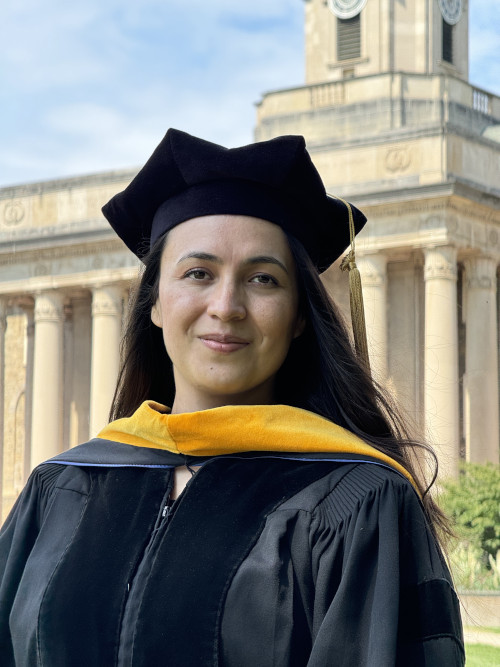
Jacob Bourjaily

I began my career in science as an undergraduate studying physics and mathematics at the University of Michigan. Upon graduation, I took up a Marshall Scholarship to pursue a degree in Mathematics at Cambridge University before starting doctoral work at Princeton University, where I earned my PhD in 2011 under the supervision of Nima Arkani-Hamed at the Institute for Advanced Study, writing a thesis on Quantum Field Theory and the Analytic S-Matrix.
After Princeton, I was elected to the Harvard Society of Fellows, where I spent several years working on what would become the book, Grassmannian Geometry of Scattering Amplitudes, published by Cambridge University Press.
I moved to Copenhagen in 2014 to join the faculty at the Niels Bohr International Academy of the University of Copenhagen, where I still maintain an affiliation. While in Copenhagen, my work earned support from the Villum Foundation and the European Research Council, allowing me to recruit and collaborate with a number of outstanding researchers (see below).
I took up my current position at Penn State in 2020, and am looking forward to many exciting years here.
ORCID: 0000-0002-3340-5667
Publications
- Jacob Bourjaily, Nikhil Kalyanapuram, Cameron Langer, Kokkimidis Patatoukos, Marcus Spradlin “Elliptic, Yangian-Invariant “Leading Singularity”.” Phys. Rev. Lett. 126 20 (2021) doi:10.1103/PhysRevLett.126.201601
- Jacob Bourjaily, Enrico Herrmann, Cameron Langer, Andrew McLeod, Jaroslav Trnka “All-Multiplicity Nonplanar Amplitude Integrands in Maximally Supersymmetric Yang-Mills Theory at Two Loops.” Phys. Rev. Lett. 124 11 (2020) doi:10.1103/PhysRevLett.124.111603
- Jacob Bourjaily, Enrico Herrmann, Cameron Langer, Jaroslav Trnka “Building Bases of Loop Integrands.” JHEP 11 (2020) doi:10.1007/JHEP11(2020)116
- Jacob Bourjaily, Andrew McLeod, Matt Hippel, Matthias Wilhelm “A (Bounded) Bestiary of Feynman Integral Calabi-Yau Geometries.” Phys. Rev. Lett. 122 3 (2019) doi:10.1103/PhysRevLett.122.031601
- Nima Arkani-Hamed, Jacob Bourjaily, Freddy Cachazo, Alexander Goncharov, Alexander Postnikov, Jaroslav Trnka “Grassmannian Geometry of Scattering Amplitudes.” (2016) doi:10.1017/CBO9781316091548
- Jacob Bourjaily, Paul Heslop, Vuong-Viet Tran “Amplitudes and Correlators to Ten Loops Using Simple, Graphical Bootstraps.” JHEP 11 (2016) doi:10.1007/JHEP11(2016)125
- Jacob Bourjaily, Simon Caron-Huot, Jaroslav Trnka “Dual-Conformal Regularization of Infrared Loop Divergences and the Chiral Box Expansion.” JHEP 01 (2015) doi:10.1007/JHEP01(2015)001
- Jacob Bourjaily, Jaroslav Trnka “Local Integrand Representations of All Two-Loop Amplitudes in Planar SYM.” JHEP 08 (2015) doi:10.1007/JHEP08(2015)119
Jacob Bourjaily's research group
| Photo | Name | Role | Affiliations | Phone | Office | Centers | Research topics | |
|---|---|---|---|---|---|---|---|---|

|
Michael Plesser | Graduate Student | Math, Physics | mkp5771@psu.edu | – | 204B Osmond Laboratory | CFT, IGC | |

|
Philip Velie | Graduate Student | Physics | pkv5088@psu.edu | n/a | 114 Osmond Laboratory | CFT | Mathematical Structures |

|
Yaqi Zhang | Graduate Student | Physics | yjz5289@psu.edu | – | na Whitmore Laboratory | CFT | Mathematical Structures |
Jacob Bourjaily's former group members
| Photo | Name | Role | Affiliations | Phone | Office | Centers | Research topics | |
|---|---|---|---|---|---|---|---|---|

|
Kokkimidis Patatoukos | Graduate Student | Physics | kzp326@psu.edu | 814 699 1747 | 005 Osmond Laboratory | CFT | Mathematical Structures |