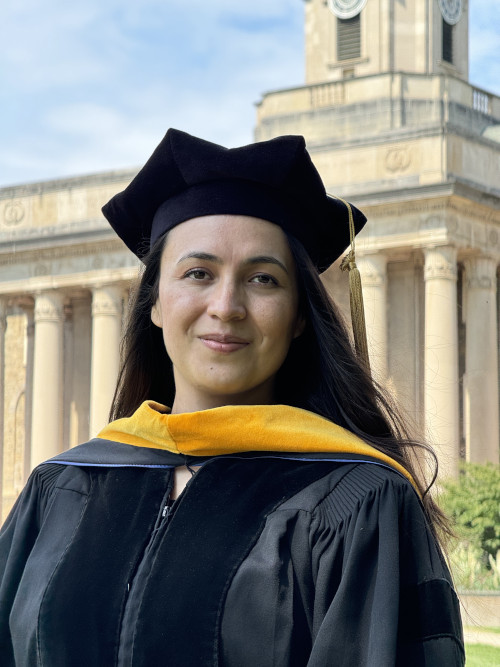
James Gurian

I am a graduate student in the Department of Astronomy and Astrophysics at Penn State, advised by Dr. Donghui Jeong. I am interested in using gravitational waves at frequencies from H0 (CMB) to Hz (LIGO) to address cosmological questions. Most of my work is related to the observation that if (some of) the dark matter can cool efficiently, it will form compact objects whose mergers may be accessible to LIGO.
Publications
- Michael Ryan, James Gurian, Sarah Shandera, Donghui Jeong “Molecular Chemistry for Dark Matter.” (2021) doi:10.48550/ARXIV.2106.13245
- James Gurian, Donghui Jeong, Michael Ryan, Sarah Shandera “Molecular Chemistry for Dark Matter II: Recombination, Molecule Formation, and Halo Mass Function in Atomic Dark Matter.” (2021) doi:10.48550/ARXIV.2110.11964
- James Gurian, Donghui Jeong, Jai-chan Hwang, Hyerim Noh “Gauge-invariant tensor perturbations induced from baryon-CDM relative velocity and the B-mode polarization of the CMB.” Phys. Rev. D 104 (2021) doi:10.1103/PhysRevD.104.083534
- Craig Copi, James Gurian, Arthur Kosowsky, Glenn Starkman, Hezi Zhang “Exploring suppressed long-distance correlations as the cause of suppressed large-angle correlations.” Monthly Notices of the Royal Astronomical Society 490 4 (2019) doi:10.1093/mnras/stz2962
James Gurian's research group
| Photo | Name | Role | Affiliations | Phone | Office | Centers | Research topics | |
|---|---|---|---|---|---|---|---|---|

|
John Blakely | Undergraduate Student | Astronomy, Physics | jpb6799@psu.edu | +1 814 865 0410 | Osmond Laboratory | CTOC, IGC | Black Holes, Dark Matter |