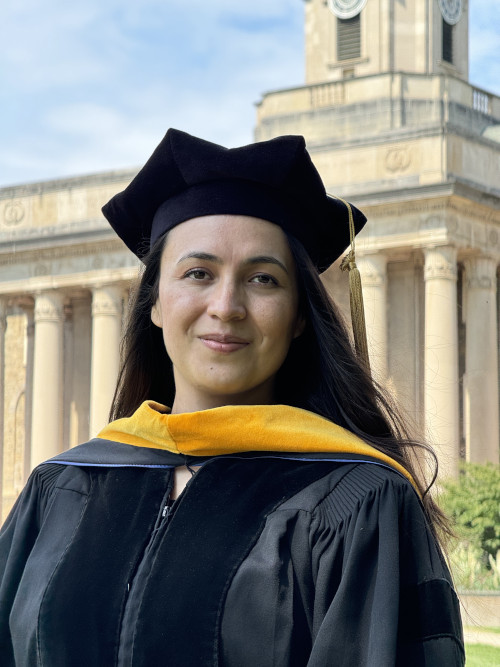
Hyungsuk Tak

Hyungsuk (Tak) Tak is an Assistant Professor of Statistics, Astronomy and Astrophysics at Penn State.
Tak received his Ph.D. in Statistics from Harvard University in 2016. He received his A.M. in Statistics from Harvard University in 2012, and a B.A. in Statistics from Korea University in 2009.
In preparation for the era of the Legacy Survey of Space and Time (LSST), Tak works closely with astronomers and astrophysicists to analyze astronomical time series and imaging data, developing practically motivated data analytic tools. Specifically, his research interests are (i) statistical challenges in astronomical data analysis (heteroscedasticity, outliers, irregularly-spaced time series, (ii) time delay cosmography for the Hubble constant estimation, (iii) statistical computation (data augmentation/missing data/Markov chain Monte Carlo), and (iv) Bayesian hierarchical modeling with frequency coverage evaluation.
Publications
- Hyungsuk Tak, Justin Ellis, Sujit Ghosh “Robust and Accurate Inference via a Mixture of Gaussian and Student’s t Errors.” Journal of Computational and Graphical Statistics 28 2 (2019) doi:10.1080/10618600.2018.1537925
- Hyungsuk Tak, Sujit Ghosh, Justin Ellis “How proper are Bayesian models in the astronomical literature?.” Monthly Notices of the Royal Astronomical Society 481 1 (2018) doi:10.1093/mnras/sty2326
- Hyungsuk Tak, Xiao-Li Meng, David Dyk “A Repelling–Attracting Metropolis Algorithm for Multimodality.” Journal of Computational and Graphical Statistics 27 3 (2018) doi:10.1080/10618600.2017.1415911