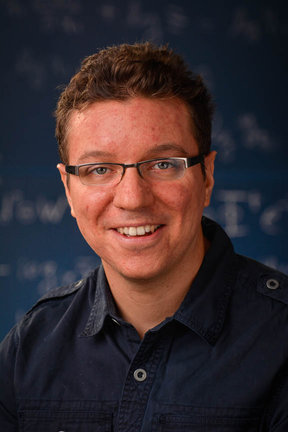
David Radice

I am an assistant professor at the Departments of Physics and Astronomy & Astrophysics of The Pennsylvania State University.
My research focuses on the study of extreme astrophysical events, such as compact binary mergers and core-collapse supernovae. To this aim I design, implement, and analyze large-scale high-performance computing general-relativistic simulations. My goal is to use simulations, in combination with gravitational-waves and electromagnetic observations, to address fundamental questions such as: what is the nature matter at extreme densities? What is the origin of heavy elements? What is the fate of massive stars? I am also interested in the development of new computational techniques and in the study of the fundamental physical processes operating in these events.
Publications
- Daniel Godzieba, David Radice, Sebastiano Bernuzzi “On the maximum mass of neutron stars and GW190814.” Astrophys. J. 908 2 (2021) doi:10.3847/1538-4357/abd4dd
- Vsevolod Nedora, Sebastiano Bernuzzi, David Radice, Boris Daszuta, Andrea Endrizzi, Albino Perego, Aviral Prakash, Mohammadtaher Safarzadeh, Federico Schianchi, Domenico Logoteta “Numerical Relativity Simulations of the Neutron Star Merger GW170817: Long-Term Remnant Evolutions, Winds, Remnant Disks, and Nucleosynthesis.” Astrophys. J. 906 2 (2021) doi:10.3847/1538-4357/abc9be
- Vsevolod Nedora, David Radice, Sebastiano Bernuzzi, Albino Perego, Boris Daszuta, Andrea Endrizzi, Aviral Prakash, Federico Schianchi “Dynamical ejecta synchrotron emission as possible contributor to the changing behaviour of GRB170817A.” (2021) doi:10.1093/mnras/stab2004
- Aviral Prakash, David Radice, Domenico Logoteta, Albino Perego, Vsevolod Nedora, Ignazio Bombaci, Rahul Kashyap, Sebastiano Bernuzzi, Andrea Endrizzi “Signatures of deconfined quark phases in binary neutron star mergers.” Phys. Rev. D 104 8 (2021) doi:10.1103/PhysRevD.104.083029
- David Radice, Sebastiano Bernuzzi, Albino Perego “The Dynamics of Binary Neutron Star Mergers and GW170817.” Ann. Rev. Nucl. Part. Sci. 70 (2020) doi:10.1146/annurev-nucl-013120-114541
- David Radice, Liang Dai “Multimessenger Parameter Estimation of GW170817.” Eur. Phys. J. A 55 4 (2019) doi:10.1140/epja/i2019-12716-4
- David Radice, Viktoriya Morozova, Adam Burrows, David Vartanyan, Hiroki Nagakura “Characterizing the Gravitational Wave Signal from Core-Collapse Supernovae.” Astrophys. J. Lett. 876 1 (2019) doi:10.3847/2041-8213/ab191a
- David Radice, Albino Perego, Francesco Zappa, Sebastiano Bernuzzi “GW170817: Joint Constraint on the Neutron Star Equation of State from Multimessenger Observations.” Astrophys. J. Lett. 852 2 (2018) doi:10.3847/2041-8213/aaa402
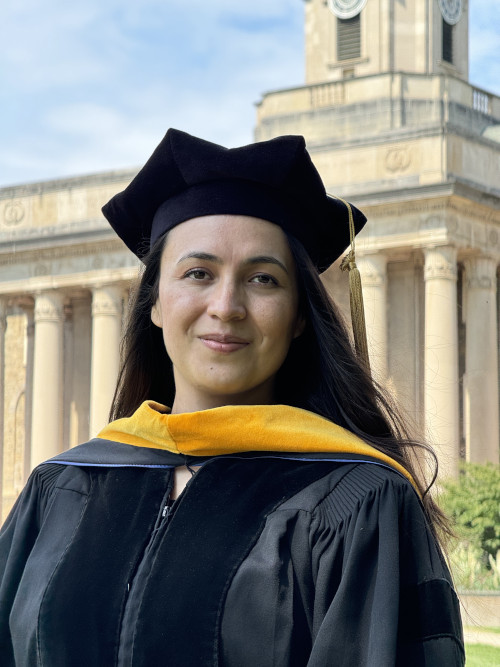
David Radice's research group
| Photo | Name | Role | Affiliations | Phone | Office | Centers | Research topics | |
|---|---|---|---|---|---|---|---|---|

|
Maitraya Bhattacharyya | Postdoc | Physics | mbb6217@psu.edu | +1 814 863 9605 | 314 Whitmore Laboratory | CMA | Black Holes, Gravitational Waves, Multimessenger Astrophysics |

|
Jacob Fields | Graduate Student | Physics | jmf6719@psu.edu | – | 321E Whitmore Laboratory | CMA | Black Holes, Gravitational Waves, Multimessenger Astrophysics |

|
Peter Hammond | Postdoc | Physics | pph5189@psu.edu | +1 814 863 9605 | 307 Whitmore Laboratory | IGC | Gravitational Waves, Multimessenger Astrophysics, Neutrinos |

|
Tetyana Pitik | Faculty | Physics | tfp5368@psu.edu | N.A. | 305 Davey Laboratory | IGC | Multimessenger Astrophysics |

|
Yi Qiu | Graduate Student | Physics | yiqiu@psu.edu | 8142328268 | 322 Whitmore Laboratory | IGC | Black Holes, Gravitational Waves, Multimessenger Astrophysics, Neutrinos |

|
Alexander Smith Clark | Postdoc | Physics | ais6179@psu.edu | 9712953644 | 312 Whitmore Laboratory | IGC | |

|
Tristan Weaver | Graduate Student | Astronomy | tsw5383@psu.edu | 9494688381 | 115 Davey Laboratory | IGC | Gravitational Waves |

|
Ruocheng Zhai | Graduate Student | Astronomy | rzhai@psu.edu | 8149542699 | 322 Whitmore Laboratory | IGC | Multimessenger Astrophysics |