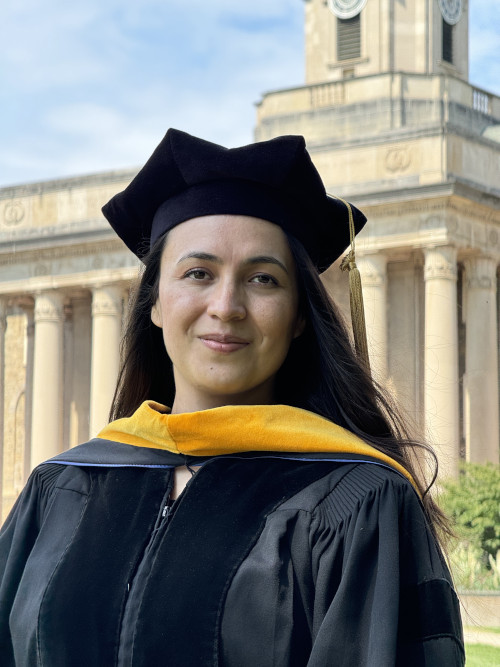
Daniel Kodroff

Hello! I'm a graduate student in the dark matter and neutrinos group lead by Professors Carmen Carmona and Luiz de Viveiros. I currently work for the LUX-ZEPLIN (LZ) collaboration, a direct detection dark matter experiment. My expertise is in background model building and constraining background rates, which is critical for searching for dark matter and other rare physics events.
Over the past few decades, a number of cosmological measurements have revealed that everything we know, all stars, subatomic particles, and everything in between, adds up to only 15% of the total matter in the universe, while the remaining 85% is made up of the still unknown dark matter. Dark matter doesn’t seem to emit, absorb, or scatter light, and it was only discovered through the gravitational influence it has on other visible matter. A large number of groups worldwide are working on experiments aiming to identify what is dark matter. The LZ experiment is an international collaboration of more than 250 physicists located at the Sanford Underground Research Laboratory in Lead, South Dakota. At the heart of the detector is a dual-phase time projection chamber utilizing a 7 tonne active volume of liquid xenon.
LZ began its first science run in 2021 and recently reported world-leading WIMP dark matter limits. Stay tuned for future results...