
Carlos Silva

Carlos Silva — PhD Candidate — Graduate Student
Office: 114 Osmond Laboratory
Address: 601 Oswald Tower, University Park, PA 16802
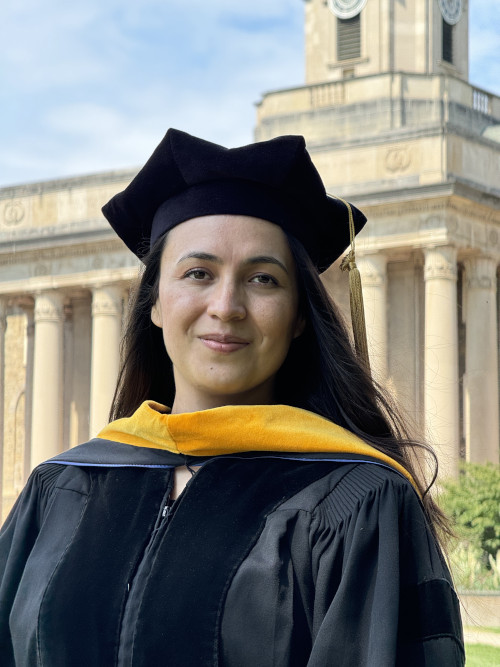
Carlos at his home in Brazil

I am a PhD student at Penn State interested in understanding how the universe works at a fundamental level. I’m especially fascinated by results that seem to follow from necessity, where consistency itself tells us that nature has to behave a certain way. Right now, I’m using machine learning, particularly autoencoders, to search for promising organic targets for dark matter detection.

Before coming to Penn State, I studied Physics and Mathematics at Georgia Tech and spent several years working with the IceCube Collaboration. My research there included searches for transient neutrino emission from gamma-ray bursts and blazars, as well as work on physics-informed transformer architectures for event reconstruction in DeepCore. Outside of physics, I hold a black belt in karate and currently serve as treasurer of Penn State’s Karate Club. I’ve also been a Dungeon Master for Dungeons & Dragons for more than ten years.

Visit my website

ORCID: 0009-0003-1307-5634

Publications
  1. {IceCube Collaboration}, C. Silva “Search for 10–1000 GeV Neutrinos from Gamma-Ray Bursts with IceCube.” The Astrophysical Journal 964 2 (2024) doi:10.3847/1538-4357/ad220b
About our wordmark
Monica Rincon Ramirez

The IGC wordmark was created by Monica Rincon Ramirez while she was a graduate student at the Institute. Monica enjoys drawing new connections between fundamental theory and observations. Her graduate work included general relativity, loop quantum gravity, and quantum fields in cosmological backgrounds; her thesis focused on effective quantum corrections to gravitational phenomena from spinfoams and applications to cosmology. She received her PhD in 2024.

The wordmark symbolizes the scope of research at the IGC. The base represents quantum gravity, evoking the quantum geometrical picture from spinfoams and loop quantum gravity — approaches studied at the Center for Fundamental Theory. The middle shows galaxies embedded in a smooth surface characteristic of spacetime in general relativity and the larger physical scales studied at the Center for Theoretical and Observational Cosmology. The top curves to an extreme representing a supermassive black hole accompanied by an energetic jet, with a binary black hole pair nearby — the high-energy phenomena studied at the Center for Multimessenger Astrophysics.