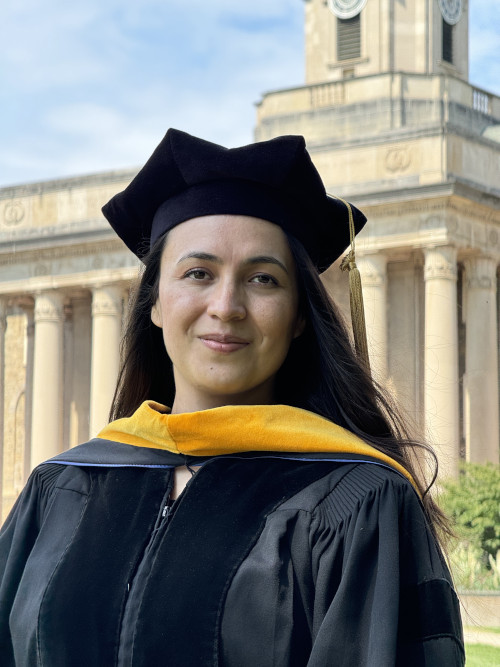
Aviral Prakash

I am a graduate student in the Department of Physics at Penn State.
Binary neutron star mergers provide excellent laboratories for probing/testing nuclear physics at extreme densities- the kind which are not replicable on Earth. My research includes modeling these mergers via a combination of strong gravity and hydrodynamics and studying the allied high energy phenomenon.
In particular I am interested in studying several aspects of QCD phase transitions from hadrons to quarks in Neutron star cores as they evolve in a binary system and possible gravitational wave imprints which can be detected by 3rd generation gravitational wave detectors.
Other research interests include development of numerical methods for relativistic hydrodynamics.
I can be reached at aup1075@psu.edu
You may follow our research group's website for latest updates: https://sites.psu.edu/numrel/
ORCID: 0000-0001-6734-3137
Publications
- Rahul Kashyap, Abhishek Das, David Radice, Surendra Padamata, Aviral Prakash, Domenico Logoteta, Albino Perego, Daniel Godzieba, Sebastiano Bernuzzi, Ignazio Bombaci, Farrukh Fattoyev, Brendan Reed, André Schneider “Numerical relativity simulations of prompt collapse mergers: threshold mass and phenomenological constraints on neutron star properties after GW170817.” (2021)
- Vsevolod Nedora, Sebastiano Bernuzzi, David Radice, Boris Daszuta, Andrea Endrizzi, Albino Perego, Aviral Prakash, Mohammadtaher Safarzadeh, Federico Schianchi, Domenico Logoteta “Numerical Relativity Simulations of the Neutron Star Merger GW170817: Long-Term Remnant Evolutions, Winds, Remnant Disks, and Nucleosynthesis.” Astrophys. J. 906 2 (2021) doi:10.3847/1538-4357/abc9be
- Vsevolod Nedora, David Radice, Sebastiano Bernuzzi, Albino Perego, Boris Daszuta, Andrea Endrizzi, Aviral Prakash, Federico Schianchi “Dynamical ejecta synchrotron emission as possible contributor to the changing behaviour of GRB170817A.” (2021) doi:10.1093/mnras/stab2004
- A Perego, D Logoteta, D Radice, S Bernuzzi, R Kashyap, A Das, S Padamata, A Prakash “Probing the incompressibility of nuclear matter at ultra-high density through the prompt collapse of asymmetric neutron star binaries.” (2021)
- Aviral Prakash, David Radice, Domenico Logoteta, Albino Perego, Vsevolod Nedora, Ignazio Bombaci, Rahul Kashyap, Sebastiano Bernuzzi, Andrea Endrizzi “Signatures of deconfined quark phases in binary neutron star mergers.” Phys. Rev. D 104 8 (2021) doi:10.1103/PhysRevD.104.083029
- Vsevolod Nedora, Federico Schianchi, Sebastiano Bernuzzi, David Radice, Boris Daszuta, Andrea Endrizzi, Albino Perego, Aviral Prakash, Francesco Zappa “Mapping dynamical ejecta and disk masses from numerical relativity simulations of neutron star mergers.” (2020)