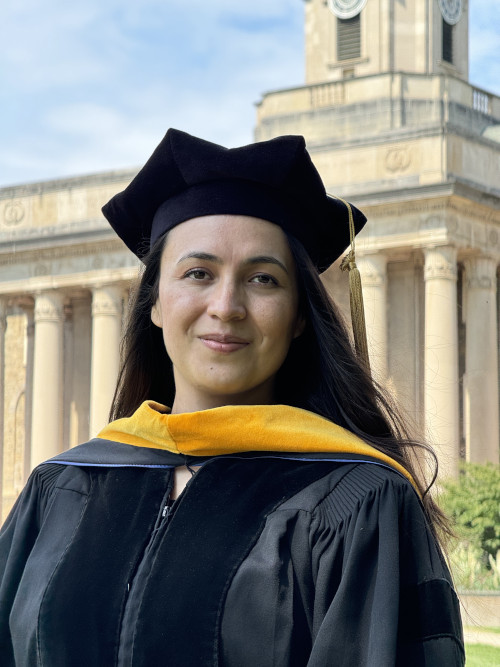
Abhishek Das
Abhishek Das
— Mr.
— Graduate Student
Office: 321E Thomas Building
Address: 104 Davey Lab, PMB #216, 251 Pollock Road, University Park, PA 16802

Astronomy
ICDS
Physics
N3AS
Black Holes
Cosmic Rays
Dark Matter
Gravitational Waves
Multimessenger Astrophysics
Neutrinos
Quasars
CMA
IGC
I am interested in and work on dynamic simulations of various astrophysical objects and processes with the goal of explaining the underlying physics in conjunction with multi messenger observation data. I am particularly interested in ultra-high energy processes as these offer us a window into regimes that are otherwise inaccessible through colliders and other terrestrial experiments. Sources of interest to me include AGNs, supernovae, binary neutron star mergers, binary black hole mergers, etc.
ORCID: 0000-0003-2916-0211
Publications
- Abhishek Das, B. Zhang, Kohta Murase “Revealing the Production Mechanism of High-energy Neutrinos from NGC 1068.” The Astrophysical Journal 972 1 (2024) doi:10.3847/1538-4357/ad5a04
- Rahul Kashyap, Abhishek Das, David Radice, Surendra Padamata, Aviral Prakash, Domenico Logoteta, Albino Perego, Daniel Godzieba, Sebastiano Bernuzzi, Ignazio Bombaci, Farrukh Fattoyev, Brendan Reed, André Schneider “Numerical relativity simulations of prompt collapse mergers: Threshold mass and phenomenological constraints on neutron star properties after GW170817.” Phys. Rev. D 105 (2022) doi:10.1103/PhysRevD.105.103022
- Fatemeh Hossein Nouri, Sukanta Bose, Matthew Duez, Abhishek Das “Nonlinear mode-tide coupling in coalescing binary neutron stars with relativistic corrections.” Phys. Rev. D 106 (2022) doi:10.1103/PhysRevD.106.083001
- Albino Perego, Domenico Logoteta, David Radice, Sebastiano Bernuzzi, Rahul Kashyap, Abhishek Das, Surendra Padamata, Aviral Prakash “Probing the Incompressibility of Nuclear Matter at Ultrahigh Density through the Prompt Collapse of Asymmetric Neutron Star Binaries.” Phys. Rev. Lett. 129 (2022) doi:10.1103/PhysRevLett.129.032701