Three Penn State researchers awarded scientific grants from Kaufman Foundation

The Charles E. Kaufman Foundation—a supporting organization of The Pittsburgh Foundation, which works to improve the quality of life in the Pittsburgh region—has selected three researchers from the Eberly College of Science to receive research grants this year. The foundation awards grants to scientists at institutes of higher learning in Pennsylvania who are pursuing research that explores essential questions in biology, physics, and chemistry, or that crosses disciplinary boundaries.
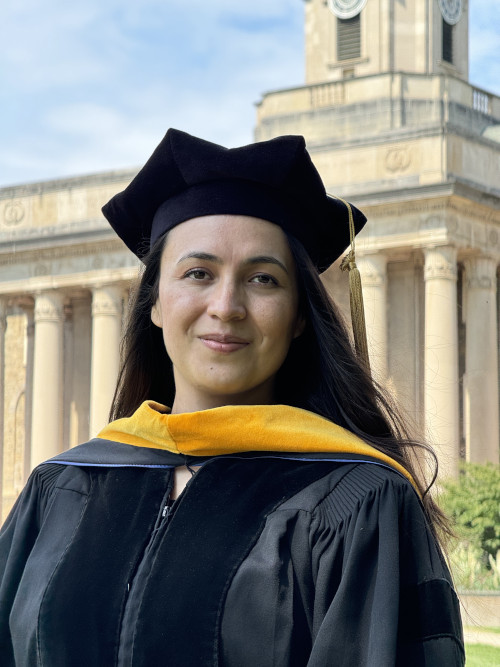
Ashley Villar, assistant professor of astronomy and astrophysics and co-hire of the Institute for Computational and Data Sciences at Penn State, was selected to receive a New Investigator grant for her project titled “Unveiling the Final Days of Stellar Life Through Exotic Explosions.” New Investigator grants empower scientists at the beginning of their careers who seek to make a mark in their fields and address core principles in biology, physics, and chemistry or across the disciplinary boundaries of these field.
Villar will study a rare type of supernova—the explosive death of a star—called a Type IIn supernova. Prior to these rare supernovae, the star produces a “death throe” for months to years before its ultimate explosion, ejecting a considerable amount of material that then surrounds the star and that becomes shock heated during the supernova. Villar will combine techniques from high energy physics, machine learning, and statistics to analyze these events and improve our understanding of why only some stars experience this phenomenon.