November 4, 2022 priority outreach

Swift telescope captures brightest gamma-ray burst ever recorded

Swift telescope captures brightest gamma-ray burst ever recorded

On October 9, 2022, an unusually bright and long-lasting gamma-ray burst—the most powerful type of explosion in the universe—was detected by the Neil Gehrels Swift Observatory, whose Mission Operations Center is located at Penn State and led by Professor of Astronomy and Astrophysics John Nousek. The burst—the brightest ever recorded, called GRB 221009A—originated from the death of a massive star about two billion light years away, likely collapsing to form a black hole and sending gamma rays, X-rays, and other particles into space.

A striking image of the burst’s afterglow was captured by Swift’s X-Ray Telescope, which is led by Penn State Research Professor of Astronomy and Astrophysics Jamie Kennea and was originally built under the leadership of Professor of Astronomy and Astrophysics David Burrows. Swift and other observatories are continuing to observe the aftermath of the event, which could help provide new insights into stellar collapse, the birth of a black hole, and the conditions in distant galaxies.
Links

Full article

About our wordmark
Monica Rincon Ramirez

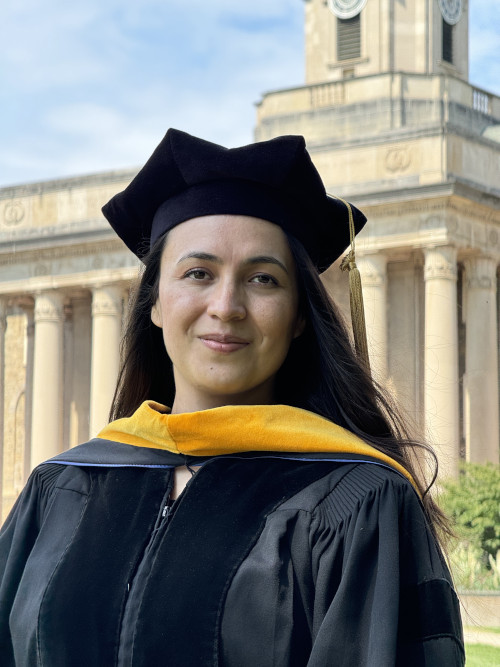
The IGC wordmark was created by Monica Rincon Ramirez while she was a graduate student at the Institute. Monica enjoys drawing new connections between fundamental theory and observations. Her graduate work included general relativity, loop quantum gravity, and quantum fields in cosmological backgrounds; her thesis focused on effective quantum corrections to gravitational phenomena from spinfoams and applications to cosmology. She received her PhD in 2024.

The wordmark symbolizes the scope of research at the IGC. The base represents quantum gravity, evoking the quantum geometrical picture from spinfoams and loop quantum gravity — approaches studied at the Center for Fundamental Theory. The middle shows galaxies embedded in a smooth surface characteristic of spacetime in general relativity and the larger physical scales studied at the Center for Theoretical and Observational Cosmology. The top curves to an extreme representing a supermassive black hole accompanied by an energetic jet, with a binary black hole pair nearby — the high-energy phenomena studied at the Center for Multimessenger Astrophysics.