David Radice awarded 2022 Sloan Research Fellowship
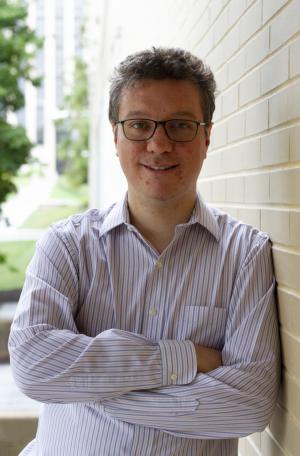
David Radice, assistant professor of physics and of astronomy and astrophysics, has been honored with 2022 Alfred P. Sloan Research Fellowship in recognition of his research accomplishments. Awarded annually since 1955, the fellowship honors extraordinary researchers whose creativity, innovation, and research accomplishments make them stand out as the next generation of scientific leaders.
"Today's Sloan Research Fellows represent the scientific leaders of tomorrow," says Adam F. Falk, president of the Alfred P. Sloan Foundation. "As formidable young scholars, they are already shaping the research agenda within their respective fields—and their trailblazing won't end here."
Radice is one of 118 outstanding researchers from 51 institutions across the U.S. and Canada to make up this year’s cohort. The fellowships are awarded in close coordination with the scientific community. Candidates must be nominated by their fellow scientists and winners are selected by independent panels of senior scholars on the basis of a candidate’s research accomplishments, creativity, and potential. A Sloan Research Fellowship is one of the most prestigious awards available to young researchers.
Radice focuses his research on the study of explosive astrophysical events that produce gravitational waves and light, such as neutron-star mergers and core-collapse supernovae. His research makes use of large-scale supercomputing simulations. He is also interested in the development of new computational techniques and in the understanding of fundamental physics questions such as the nature of turbulence.
Radice’s honors and awards include an Early Career Research Program Award from the Department of Energy in 2020, a Giulio Rampa Thesis Prize from the University of Pavia in 2014, and a Prize Postdoctoral Fellowship from the California Institute of Technology in 2013.
Prior to joining the faculty at Penn State, Radice was an associate research scholar at Princeton University and at the Institute for Advanced Study from 2016 to 2019 and a Walter Burke Fellow in Theoretical Astrophysics and Relativity at the California Institute of Technology from 2013 to 2016. He earned a doctoral degree in gravitational wave astronomy at the Max Planck Institute for Gravitational Physics, Germany, in 2013 and master’s and bachelor’s degrees in mathematical engineering at Politecnico di Milanoin Italy in 2009 and 2006, respectively.