October 1, 2020 outreach

Celebrating Sir Roger’s Nobel Prize in Physics

Roger Penrose is a founding (visiting) member of IGC since 1993 and has served on its Scientific Advisory Board since 2009. He held the Francis R. and Helen M. Pentz Distinguished Professorship in Physics and Mathematics at Penn State from 1993 to 2012. On 12th October 2020, IGC celebrated his 2020 Nobel prize in Physics for “the discovery that black hole formation is a robust prediction of the general theory of relativity” through a special event. B. Sathyaprakash and Don Schneider explained the Theoretical and Observational background behind the discoveries that led to the Nobel Prize. Abhay Ashtekar and Nitin Smarath spoke on Roger’s dazzling contributions to Physics, Mathematics and on how his regular visits enriched the Penn State Community. 140-150 Colleagues and friends joined the event from all over the world.
Links

Full article

About our wordmark
Monica Rincon Ramirez

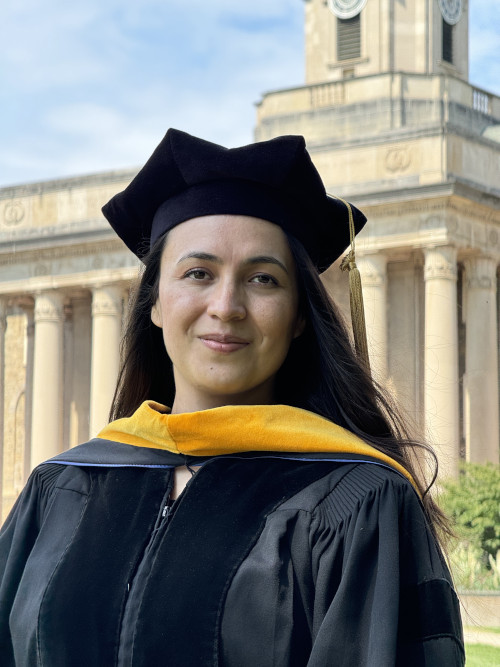
The IGC wordmark was created by Monica Rincon Ramirez while she was a graduate student at the Institute. Monica enjoys drawing new connections between fundamental theory and observations. Her graduate work included general relativity, loop quantum gravity, and quantum fields in cosmological backgrounds; her thesis focused on effective quantum corrections to gravitational phenomena from spinfoams and applications to cosmology. She received her PhD in 2024.

The wordmark symbolizes the scope of research at the IGC. The base represents quantum gravity, evoking the quantum geometrical picture from spinfoams and loop quantum gravity — approaches studied at the Center for Fundamental Theory. The middle shows galaxies embedded in a smooth surface characteristic of spacetime in general relativity and the larger physical scales studied at the Center for Theoretical and Observational Cosmology. The top curves to an extreme representing a supermassive black hole accompanied by an energetic jet, with a binary black hole pair nearby — the high-energy phenomena studied at the Center for Multimessenger Astrophysics.