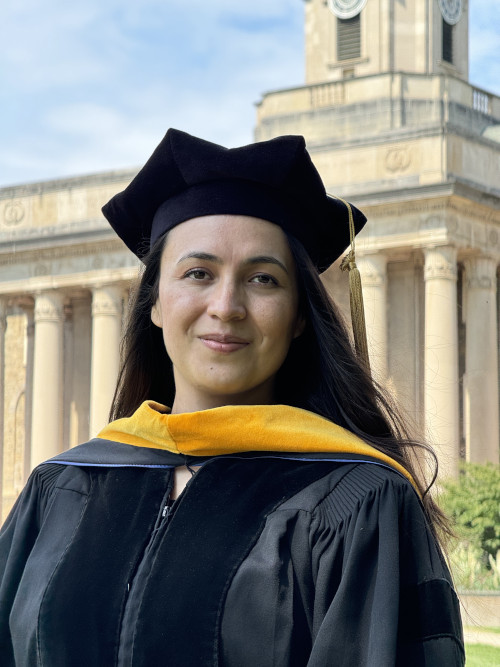
Abstract: With the recent discovery of an ultra high energy (>100 PeV) neutrino by KM3NeT. and the ongoing development of serval next-generation detectors, we will soon have the opportunity to explore the universe at the hightest energies. In this talk, I will hightlight the scientific opportunities persented by ultra high energy neutrinos and the uniques methods by which we may detect them.
Schedule for PUG Seminar
Time
Speaker
Title
13:00
Andrew Zeolla
Detecting Cosmic Neutrions at the Highest Energies
About our wordmark
The IGC wordmark was created by Monica Rincon Ramirez, while she was a graduate
student at the Institute for Gravitation and the Cosmos (IGC). Monica enjoys
drawing new connections between fundamental theory and observations. Her
graduate work includes specialized topics in general relativity, loop quantum
gravity, and quantum fields in cosmological backgrounds. In particular, her
thesis work focused on finding effective quantum corrections to gravitational
phenomena from spinfoams, and applications to cosmology. She received her PhD
in 2024.
The wordmark symbolizes the scope and variety of research at the IGC. The base
of the image represents quantum gravity, evoking the quantum geometrical
picture from spinfoams and loop quantum gravity. These are among the approaches
to fundamental questions studied at the Center for Fundamental Theory. The
middle of the image represents the Center for Theoretical and Observational
Cosmology by galaxies embedded in a smooth surface, characteristic of spacetime
in general relativity and the much larger physical scales studied in cosmology.
Finally, at the top, the surface curves to an extreme, representing a
supermassive black hole accompanied by an energetic jet. These elements depict
an active galactic nucleus, inspired by Centaurus A. Just to the right, a pair
of black holes approaches merger. This top portion of the wordmark represents
the Center for Multimessenger Astrophysics, which specializes in the study of
high-energy phenomena in the universe.