Celebration of the 10-year Anniversary of the First Detection of Gravitational Waves

Celebration of the 10-year Anniversary of the First Detection of Gravitational Waves

117 Osmond Laboratory, https://psu.zoom.us/s/97914500117

2025-09-11

Title: “Gravitational-Wave Physics, Astrophysics, and Cosmology: The First Decade and Beyond”

Gravitational-wave observations have ushered in a new era in physics and astronomy, giving us the ability to witness the dynamics of spacetime directly. In less than a decade, detections by LIGO and Virgo have revealed unexpected populations of black holes and neutron stars, challenging long-standing ideas of how massive stars form, evolve, and die. The multi-messenger event GW170817 was transformative: it demonstrated the cosmic origin of heavy elements, established gravitational waves as “standard sirens” for cosmology, confirmed that gravity and light travel at the same speed. Gravitational-wave observations have also provided unprecedented tests of general relativity in the strong-field, dynamical regime—and Einstein’s theory remains unshaken. Yet current detectors can probe only the nearby Universe. Next-generation observatories—Cosmic Explorer and the Einstein Telescope—will open access to black hole mergers at cosmic dawn and neutron star mergers beyond the epoch of peak star formation. Together, they promise discoveries that will reshape astrophysics, cosmology, and fundamental physics.

Schedule for Celebration of the 10-year Anniversary of the First Detection of Gravitational Waves
TimeSpeakerTitle
15:30B.S. Sathyaprakash“Gravitational-Wave Physics, Astrophysics, and Cosmology: The First Decade and Beyond”

About our wordmark
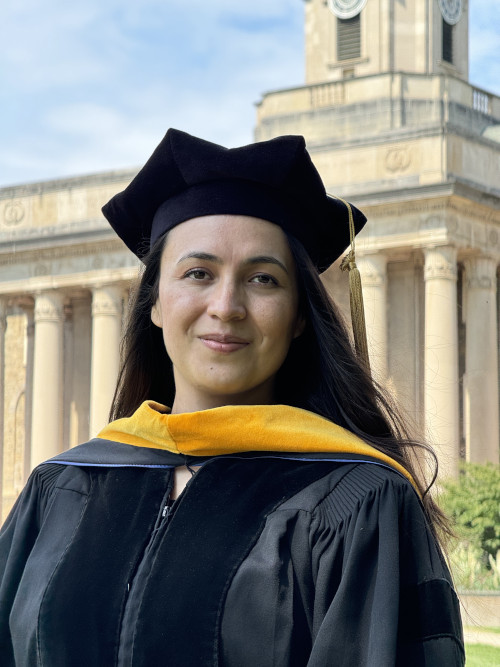
Monica The IGC wordmark was created by Monica Rincon Ramirez, while she was a graduate student at the Institute for Gravitation and the Cosmos (IGC). Monica enjoys drawing new connections between fundamental theory and observations. Her graduate work includes specialized topics in general relativity, loop quantum gravity, and quantum fields in cosmological backgrounds. In particular, her thesis work focused on finding effective quantum corrections to gravitational phenomena from spinfoams, and applications to cosmology. She received her PhD in 2024.

The wordmark symbolizes the scope and variety of research at the IGC. The base of the image represents quantum gravity, evoking the quantum geometrical picture from spinfoams and loop quantum gravity. These are among the approaches to fundamental questions studied at the Center for Fundamental Theory. The middle of the image represents the Center for Theoretical and Observational Cosmology by galaxies embedded in a smooth surface, characteristic of spacetime in general relativity and the much larger physical scales studied in cosmology. Finally, at the top, the surface curves to an extreme, representing a supermassive black hole accompanied by an energetic jet. These elements depict an active galactic nucleus, inspired by Centaurus A. Just to the right, a pair of black holes approaches merger. This top portion of the wordmark represents the Center for Multimessenger Astrophysics, which specializes in the study of high-energy phenomena in the universe.