Special CAMP Seminar
339 Davey and https://psu.zoom.us/j/96720940863?pwd=a3FhYTdUM0dBdGRXZ3NWUzIrTmpvUT09 - Password: 804956

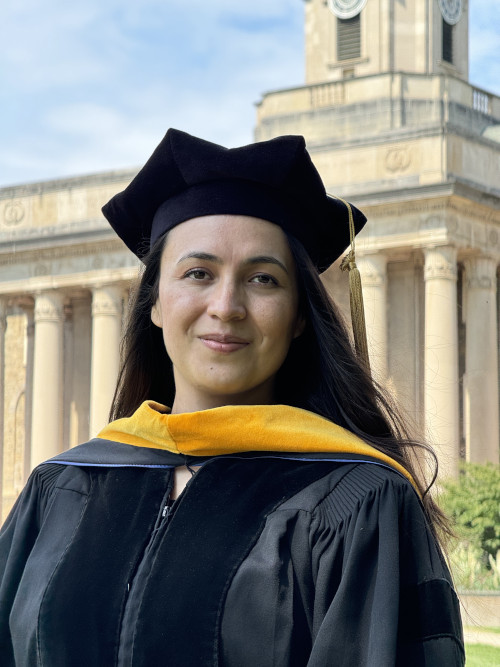
Prof. Zhida Song from Peking University will give a special CAMP seminar talk entitled: Kondo Phase in Twisted Bilayer Graphene - A Unified Theory for Distinct Experiments.
Abstract: A number of interesting physics phenomena have been discovered in magic-angle twisted bilayer graphene(MATBG), such as superconductivity, correlated gapped and gapless phases, etc. The gapped phases are believed to be symmetry-breaking states described by mean-field theories. Gapless phases, however, exhibit exotic phenomena beyond naive mean-field descriptions. Such phenomena include (i) zero-energy peaks in spectral density at low temperatures, (ii) a cascade of transitions as that of a quantum dot at higher temperatures, (iii) the Pomeranchuk effect where local moment develops upon heating, (iv) resistance peaks in gapless phases at certain integer fillings, etc. These phenomena have never been connected or explained on a microscopic level by any prior theory. In this work, we point out that all these phenomena result from a simple unified mechanism- the Kondo effect. We applied systematic analytical and numerical renormalization group analyses to a singleimpurity version of the recently proposed topological heavy fermion (THF) model of MATBG. We find that the Fermi liquid ground state exhibiting (i) zero-energy peaks is stabilized by the Kondo screening effect. A higher temperature will drive the system into a local moment phase that obeys Curie’s law and has higher entropy. This explains the (ii) transition cascade, (iii) the Pomeranchuk effect, and (iv) resistance peaks. Remarkably, using realistic parameters given by the previous THF model work, the computed spectral densities, entropies, and spin susceptibilities are quantitatively comparable to experiments. Furthermore, we predict that the ground state in a wide range of fractional fillings is the heavy Fermi liquid, and compute its dispersion, quasi-particle weight, and energy surfaces that could be used to verify our theory if compared to experiments in the future studies. We conjecture that the heavy Fermi liquid is the parent state of the observed unconventional superconductivity. It is also possible that the observed “strange metal” behavior could be connected to the competition between RKKY interaction and Kondo screening.
Program
| Date | Time | Speaker | Title |
|---|---|---|---|
| 2023-06-05 | 10:15 | Zhi-Da Song | Kondo Phase in Twisted Bilayer Graphene - A Unified Theory for Distinct Experiments. |