Collaboration
LUX-Zeplin
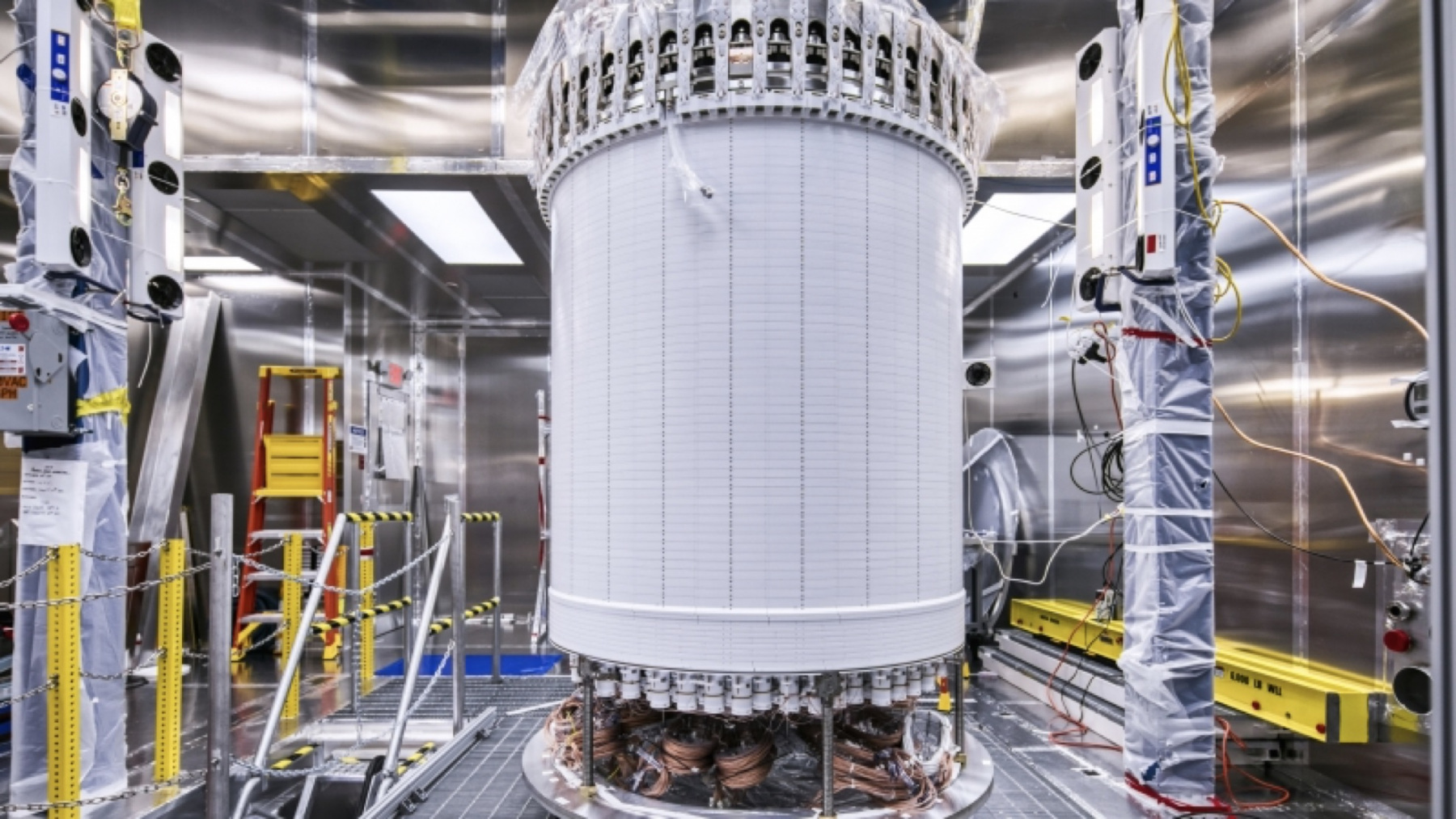
LUX-ZEPLIN (LZ) is a next generation dark matter experiment, selected by the US Department of Energy (DOE) as one of the three ‘G2’ (for Generation 2) dark matter experiments. Located at the 4850′ level of the Sanford Underground Research Facility in Lead, SD, the experiment utilizes a two-phase time projection chamber (TPC), containing seven active tonnes of liquid xenon, to search for dark matter particles. Auxiliary veto detectors, including a liquid scintillator outer detector, improve rejection of unwanted background events in the central region of the detector. LZ has been designed to improve on the sensitivity of the prior generation of experiment by a factor of 50 or more. [Text and image from https://lz.lbl.gov/]
| Photo | Name | Role | Affiliations | Phone | Office | Centers | Research topics | |
|---|---|---|---|---|---|---|---|---|

|
Carmen Carmona Benitez | Faculty | Physics | mzc267@psu.edu | +1 814 865 6476 | 320D Osmond Laboratory | CMA | Dark Matter, Neutrinos |

|
Yen-Ting Chin | Graduate Student | Physics | ypc5402@psu.edu | 18144248968 | Osmond Laboratory | CMA | Dark Matter |

|
Jack Genovesi | Postdoc | Physics | jgg27@psu.edu | 8455197418 | 320A Osmond Laboratory | IGC | Dark Matter |

|
Katherine Wild | Graduate Student | Physics | kvw5673@psu.edu | (954) 225-1854 | 108 Osmond Laboratory | IGC | Dark Matter |

|
Wei Zha | Graduate Student | Physics | wpz5141@psu.edu | – | 114 Whitmore Laboratory | IGC | Dark Matter |

|
Luiz de Viveiros | Faculty | Physics | lad57@psu.edu | +1 814 865 7533 | 320E Osmond Laboratory | CMA | Dark Matter, Neutrinos |
| Photo | Name | Role | Affiliations | Phone | Office | Centers | Research topics | |
|---|---|---|---|---|---|---|---|---|

|
Daniel Kodroff | Graduate Student | Physics | dsk192@psu.edu | 0000000000 | Basement Osmond Laboratory | CMA | Dark Matter, Neutrinos |