Collaboration
Beamforming Elevated Array for COsmic Neutrinos
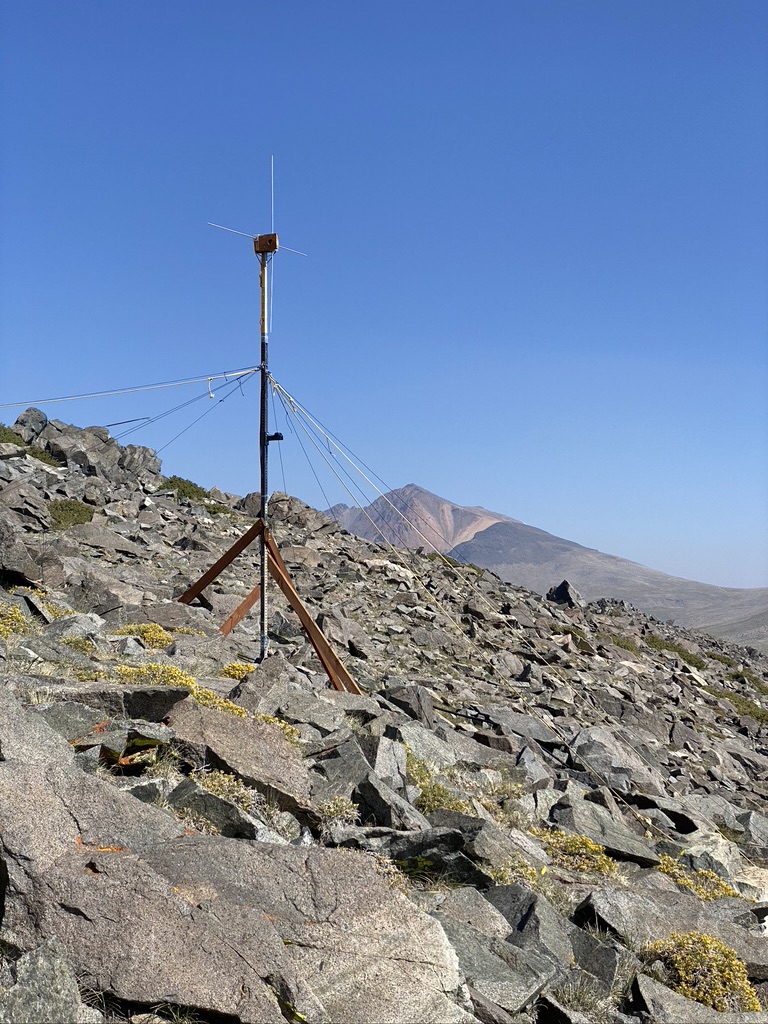
The Beamforming Array for COsmic Neutrinos can search for tau neutrinos with energies above 100 PeV. The concept places a compact radio inferometer on top of a high-elevation mountain to look for radio emission indicating tau neutrino interactions in the rock. Antennas in the array are trained on the horizon to search for radio emission from air showers.
| Photo | Name | Role | Affiliations | Phone | Office | Centers | Research topics | |
|---|---|---|---|---|---|---|---|---|

|
Ryan Krebs | Graduate Student | Physics | rjk5416@psu.edu | (814) 865-7533 | 322 Osmond Laboratory | CMA, IGC | Multimessenger Astrophysics, Neutrinos |

|
James Tutt | Faculty | Astronomy | jht12@psu.edu | +1 814 865 6338 | 128A Davey Laboratory | IGC | Neutrinos |

|
Andrew Zeolla | Graduate Student | Physics | avz5228@psu.edu | 7138709006 | 204 Osmond Laboratory | CMA | Cosmic Rays, Multimessenger Astrophysics, Neutrinos |
| Photo | Name | Role | Affiliations | Phone | Office | Centers | Research topics | |
|---|---|---|---|---|---|---|---|---|

|
Valentin Decoene | Postdoc | Physics | vxd5110@psu.edu | +1 814 865 7533 | 320L Osmond Laboratory | CMA, IGC | Cosmic Rays, Multimessenger Astrophysics, Neutrinos |

|
Kaeli Hughes | Postdoc | Astronomy, Physics | kaeli@psu.edu | +1 6142906343 | N/A Davey Laboratory | CMA | Cosmic Rays, Multimessenger Astrophysics, Neutrinos |