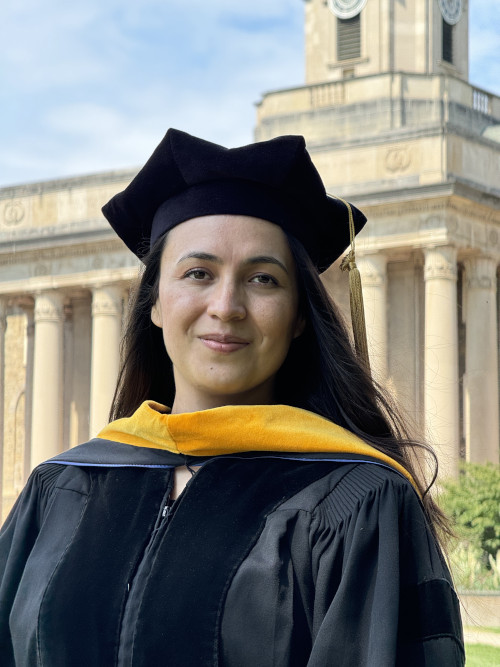
Two IGC Members recieve Awards from the Fox Graduate School

Graduate Student International Research Award
Sanika Khadkikar
Sanika Khadkikar, a doctoral candidate in physics, is being recognized for her internationally collaborative research on some of the universe’s most extreme objects: neutron stars. These stars, so dense that a teaspoon of their matter would weigh more than a mountain, produce ripples in space‑time when they collide, known as gravitational waves. Sanika’s research focuses on developing new ways to decode these signals to better understand the fundamental physics at play inside neutron stars, including how the universe forges heavy elements such as gold and platinum.
Because gravitational wave science is inherently global, Sanika’s research spans multiple countries and scientific communities. She collaborates with teams at major research centers across Europe, including the University of Southampton in England; the National Centre for Scientific Research in France; the Gran Sasso Science Institute in Italy; the Max Planck Institute in Germany; and Utrecht University in the Netherlands. These groups are instrumental in planning and designing the next generation of gravitational wave observatories: vast, high‑precision instruments that will allow scientists to detect hundreds of thousands of cosmic events each year.
By working directly with international experts who are shaping these future observatories, Sanika is supporting researchers worldwide to accurately interpret the wealth of data these instruments will collect.
Shio Sakon
Shio Sakon, a doctoral candidate in physics, is being recognized for transformative contributions that enhance how scientists detect and interpret ripples in spacetime. Working within a gravitational-wave search pipeline known as GstLAL, Sakon contributed to the development of a new method for generating template banks, which are simulated waveforms used to identify real gravitational‑wave signals. This reduced computational time from weeks to hours while maintaining state‑of‑the‑art performance. This innovation enabled faster tuning and the discovery of more than 250 significant events in the most recent LIGO–Virgo–KAGRA Collaboration’s observing run.
Her analyses helped explain several extraordinary detections, including record‑mass black‑hole mergers, and clarified why certain signals stand out in specialized searches. Sakon also leads work on sub‑solar‑mass systems, probing exotic compact‑object scenarios connected to dark‑matter theories, and contributed to population‑inference studies that revealed structures in the black‑hole mass spectrum.
Through advances spanning low‑latency detection, algorithm design and astrophysical interpretation, Sakon’s research ensures that gravitational‑wave astronomy remains fast, reliable and ready for multi‑messenger discovery in the years ahead.