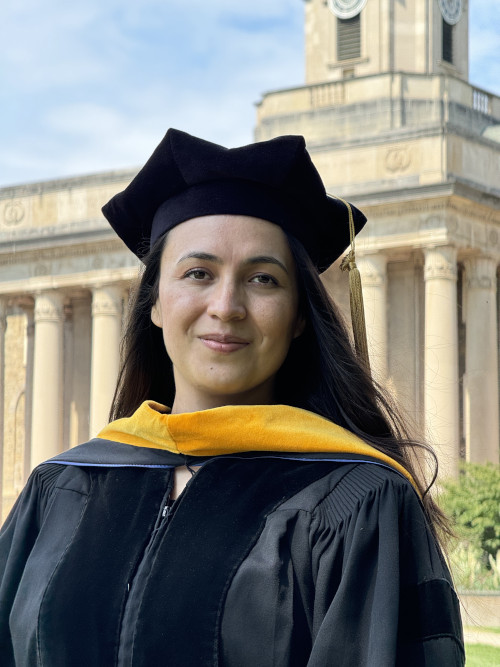
Jainendra Jain named 2025 Wolf Prize laureate in physics

Jainendra K. Jain, Evan Pugh University Professor and Erwin W. Müller Professor of Physics and holder of the Eberly Family Chair in the Penn State Eberly College of Science, has been awarded, along with two others, the 2025 Wolf Prize in Physics for “groundbreaking contributions to quantum matter and its topological potential” that revolutionized “our understanding of two-dimensional electron systems in strong magnetic fields.”
The Wolf Prize acknowledges scientists and artists worldwide for their outstanding achievements in advancing science and the arts for the betterment of humanity.
"The Wolf Prize is one of the highest honors in the world of science, and this well-deserved recognition of Dr. Jain’s extraordinary contributions is a proud moment for Penn State," said Penn State President Neeli Bendapudi. "For over 30 years, his groundbreaking work in theoretical physics has deepened our understanding of quantum matter, paving the way for real-world innovations in high-performance electronics and quantum computing. His research exemplifies the power of university-driven discovery, and we celebrate this prestigious recognition of his remarkable achievements."
In his early theory research, Jain introduced a class of exotic particles called composite fermions, explaining a new state of matter consisting of the intricate sequence of fractional quantum Hall states, now known as Jain states. Jain described the composite fermion as an electron trapped inside a quantum vortex in this strange liquid, sometimes thought of as an electron bound to a quantized magnetic field.
“I am immensely grateful to the Wolf Foundation for welcoming me into this truly esteemed community of scientists for my introduction of composite fermions. The honor truly belongs to my students, collaborators, and numerous other researchers whose brilliant work transformed composite fermions from an idea to reality,” Jain said. “Looking back, it is hard to believe how incredibly fortunate I have been. Growing up in a poor village in India, traumatized by an accident that left me on crutches with a lifelong disability, I did not think I would ever walk again or attend college, let alone pursue my dream of becoming a physicist. I don’t have words to express my profound gratitude to my family, friends, colleagues, and even strangers who have helped and supported me throughout my journey to make this possible.
“When the idea of composite fermions first struck me during the Christmas break of 1988, I did not know that these particles would occupy my mind every day for the next 37 years. My hope is that this prize will motivate a few more to experience the beauty of nature through composite fermions.”
Under certain conditions, composite fermions form a superconductor — or a material that can conduct electricity without losing any energy at low temperatures — that theorists predicted would contain an even stranger particle, called a Majorana, which is its own antiparticle (a particle with the same mass but different charge).
“These discoveries advance high performance electronics, enabling ultra-low resistance materials and topological quantum computing,” the Wolf Foundation shared in its award presentation on March 10. “They reveal complex quantum behaviors, guiding novel materials with revolutionary properties.”
Just last month, Microsoft announced a potential breakthrough in quantum computing based, in part, on the early work of Jain and others in this space.
“I am on the theoretical understanding side of this spectrum, but I work closely with scientists who test whether the theories correspond to reality,” Jain said in a recent Penn State News article. “The news from Microsoft is an example of how basic research at universities could lead to real-world applications that drive innovation — like quantum computers.”
The Wolf Prize is awarded annually and honors exceptional individuals who transcend barriers of religion, gender, race, geography, and political stance, according to the organization’s website. In the scientific domain, the awards are conferred in medicine, agriculture, mathematics, chemistry, and physics. In the arts, the awards recognize excellence in painting and sculpture, music, and architecture.