New grants to support neutron star research and undergraduate exchange program

A pair of new grants from the U.S. National Science Foundation (NSF) and the German Research Foundation (DFG) will support an international research collaboration and student exchange program between Penn State and the University of Jena in Germany. The grants will support research to produce a database of simulations of neutron stars merging with other neutron stars or black holes. This work will not only explore the physics of incredibly energetic cosmic events but also lend insight into how rare-earth elements and heavy metals are formed and provide a frame of reference to interpret future observations of merger emissions.
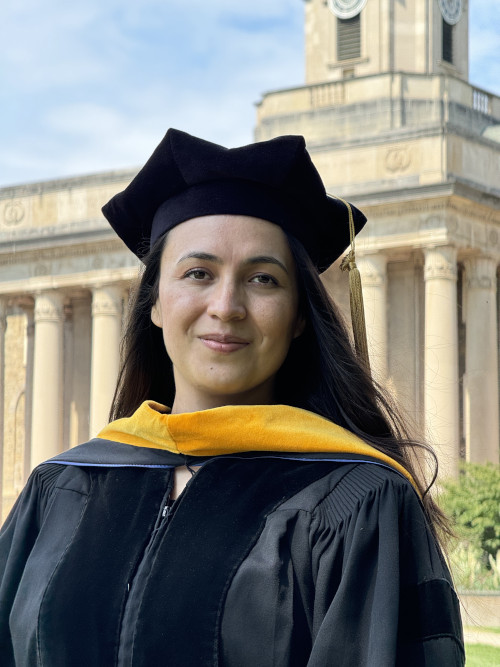
The $392,000 NSF grant is awarded to David Radice, Knerr Early Career Professor of Physics and and associate professor astronomy and astrophysics in the Eberly College of Science at Penn State, and the DFG grant is awarded to Radice’s colleagues in Germany.
The collision and merger of two neutron stars, or of a neutron star with a black hole, are some of the most energetic events in the universe. These events produce gravitational waves, or ripples in space time that can be detected on Earth with observatories like NSF’s Laser Interferometer Gravitational-Wave Observatory (LIGO). Mergers also often result in the ejection of matter into space, which produces electromagnetic radiation like gamma rays, X-rays, and visible light that can be detected with ground-based observatories like NSF’s Vera Rubin Observatory and space-based observatories like NASA’s James Webb Space Telescope.