September 9, 2024

How do supermassive black holes get super massive?

How do supermassive black holes get super massive?

UNIVERSITY PARK, Pa. — By combining forefront X-ray observations with state-of-the-art supercomputer simulations of the buildup of galaxies over cosmic history, researchers have provided the best modeling to date of the growth of the supermassive black holes found in the centers of galaxies. Using this hybrid approach, a research team led by Penn State astronomers derived a complete picture of black-hole growth over 12 billion years, from the Universe’s infancy at around 1.8 billion years old to now at 13.8 billion years old.
Links
About our wordmark
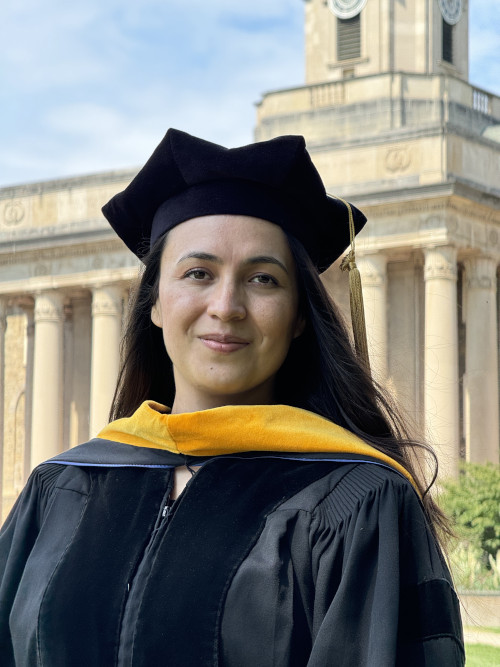
Monica Rincon Ramirez

The IGC wordmark was created by Monica Rincon Ramirez while she was a graduate student at the Institute. Monica enjoys drawing new connections between fundamental theory and observations. Her graduate work included general relativity, loop quantum gravity, and quantum fields in cosmological backgrounds; her thesis focused on effective quantum corrections to gravitational phenomena from spinfoams and applications to cosmology. She received her PhD in 2024.

The wordmark symbolizes the scope of research at the IGC. The base represents quantum gravity, evoking the quantum geometrical picture from spinfoams and loop quantum gravity — approaches studied at the Center for Fundamental Theory. The middle shows galaxies embedded in a smooth surface characteristic of spacetime in general relativity and the larger physical scales studied at the Center for Theoretical and Observational Cosmology. The top curves to an extreme representing a supermassive black hole accompanied by an energetic jet, with a binary black hole pair nearby — the high-energy phenomena studied at the Center for Multimessenger Astrophysics.