May 2, 2020 outreach

LIGO detects another probable Neutron Star collision
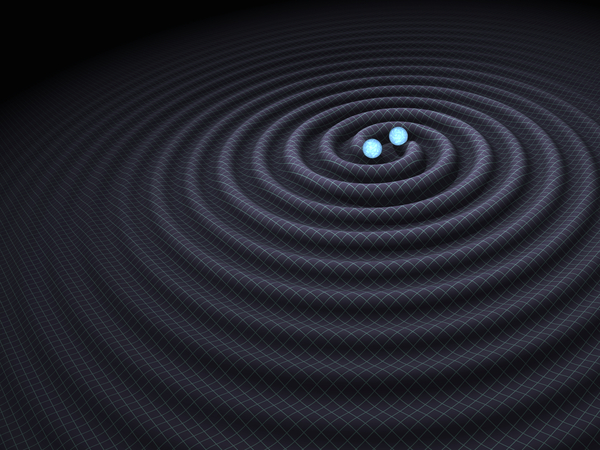
LIGO detects another probable Neutron Star collision

Gravitational waves detected on April 25, 2019, by the LIGO Livingston Observatory were likely produced by a collision of two neutron stars, according to a new study by an international team including Penn State researchers. IGC members Patrick Godwin, Ryan Magee, B. Sathyaprakash and Surabhi Suchdev explain why this discovery is so exciting. This detection was made possible by the GSTLAL online software developed by faculty and postdocs at the Institute for Gravitation and the Cosmos. The total mass of the binary is significantly larger than all such systems we know in our galaxy and challenging astrophysical models of the formation of binary black holes.

Links

Full article

About our wordmark
Monica Rincon Ramirez

The IGC wordmark was created by Monica Rincon Ramirez while she was a graduate student at the Institute. Monica enjoys drawing new connections between fundamental theory and observations. Her graduate work included general relativity, loop quantum gravity, and quantum fields in cosmological backgrounds; her thesis focused on effective quantum corrections to gravitational phenomena from spinfoams and applications to cosmology. She received her PhD in 2024.

The wordmark symbolizes the scope of research at the IGC. The base represents quantum gravity, evoking the quantum geometrical picture from spinfoams and loop quantum gravity — approaches studied at the Center for Fundamental Theory. The middle shows galaxies embedded in a smooth surface characteristic of spacetime in general relativity and the larger physical scales studied at the Center for Theoretical and Observational Cosmology. The top curves to an extreme representing a supermassive black hole accompanied by an energetic jet, with a binary black hole pair nearby — the high-energy phenomena studied at the Center for Multimessenger Astrophysics.