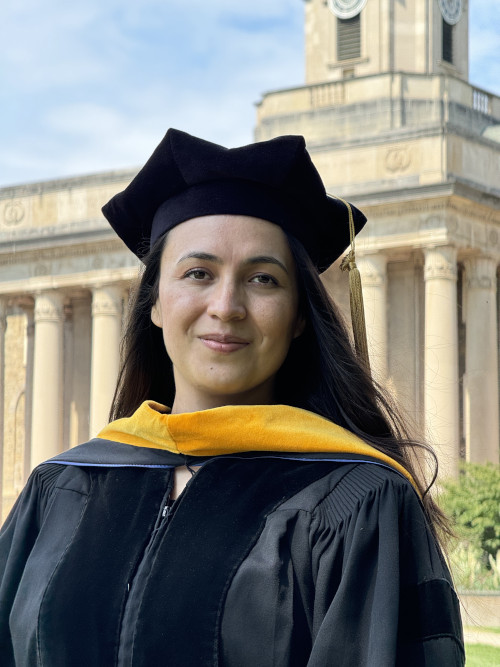
Strong Gravity Seminar
320 Whitmore Laboratory

I will present numerical-relativity simulations of equal-mass, non-spinning black hole encounters at highly relativistic velocities, reaching center-of-mass Lorentz factors of 5, corresponding to approximately 98% of the speed of light. Near the threshold separating merger from scattering, the dynamics exhibit prolonged and "irregular" gravitational-wave emission that differs substantially from the familiar inspiral-merger-ringdown behavior of astrophysical binary black holes. We find that this emission is associated with transient trapping and repeated lensing of gravitational radiation in the highly dynamical spacetime between the black holes. The individual horizons can also absorb a substantial amount of radiation during close encounters, including in cases where the black holes ultimately scatter rather than merge. At the largest boosts considered, more than 65% of the initial ADM energy is radiated away as gravitational waves, substantially exceeding extrapolations from previous simulations at lower velocities. These results characterize a qualitatively distinct regime of the relativistic two-body problem and provide new insight into black hole dynamics in the high-energy limit.
Program
| Date | Time | Speaker | Title |
|---|---|---|---|
| 2026-11-06 | 11:00 | Hengrui Zhu | Black Hole Encounters Near the Speed of Light |